

An IPL photofacial uses pulses of filtered light to clear brown spots and small red vessels, which the body then carries away over the following days. Coastal Dermatology + Aesthetics performs it at its San Luis Obispo office after assessing skin type. Most people need three to five sessions about four weeks apart.
What an IPL photofacial does for your skin
Two things make skin look weathered rather than older: brown patches where the sun has left pigment behind, and small red veins that have surfaced and stayed. Creams do not reach either of them. Light does, because both of them absorb it.
A pulse of filtered light passes through the surface of your skin and is soaked up by the brown and the red specifically, leaving everything around them alone. What it hits breaks apart. Over the next week or two your body clears the debris, brown spots darken and flake away, and the redness fades. What is left is your own skin with the weathering taken off it.
This is a course rather than a single visit. Most people book three to five sessions about a month apart, because each one takes a layer of the problem rather than all of it, and gradual is what keeps the result looking natural.
What IPL is good at
- Clearing sun spots and brown patches on the face, chest, shoulders and hands
- Fading the general background redness that comes with rosacea
- Clearing the small broken red veins that surface around the nose and cheeks
- Lifting the brown patches of melasma, as one part of a plan built around it
- Evening out overall tone so skin looks brighter rather than treated
- Covering a large area in one visit rather than spot by spot
- Being combined with resurfacing in the same appointment, which is what ThreeForMe does
Brown and red, treated in the same pass. The light is absorbed by pigment and by blood vessels and ignores the skin around them, which is why one session improves two different problems at once.
How treatment works
We look at your skin first
Skin tone, sun exposure and what the marks on your skin actually are all change the settings, and one of them changes whether we treat you at all. A dermatologist examines any pigmented spot before light goes anywhere near it.
The pulse
Filtered light passes into the skin and is absorbed by the brown and the red rather than by everything around it. It feels like a warm snap, described by most people as a rubber band flick, and a full face takes under half an hour.
Your body clears it
Over the next three to fourteen days the treated spots darken, go crisp and flake off, and the redness settles. That flaking is not a side effect, it is the treatment working, and it is the reason we tell you to plan the week rather than promising no downtime.
Sessions in a typical course, about four weeks apart. Each one takes a layer rather than all of it, which is what keeps the result looking like clear skin rather than like a treatment.
Why we ask about your skin tone and your tan
This is the part most pages in this market leave out, and it is the part that decides whether you get a good result or a problem.
IPL works by being absorbed by pigment. That is the whole mechanism, and it is also the catch: a tan is pigment too. Treat skin that has been in the sun and the light goes into the tan rather than into the spot, which is how people end up with burns, blisters, or pale and dark patches that can take months to settle. The same logic applies to deeper skin tones, where more pigment sits throughout the skin and the settings have to account for it. Getting that judgment right is most of the outcome, and it is the reason this is a physician’s decision rather than a setting someone picks off a chart.
So we ask you to stay out of the sun and off sunbeds for two weeks before your appointment, and self-tanner counts as a tan. If you arrive with color, we will move you rather than treat you, which is not us being difficult.
One more thing, and it is the reason a dermatology practice is the right place for this. Every pigmented mark is examined by a dermatologist before any light goes near it, by someone qualified to tell one kind of brown spot from another. That check costs you nothing and it is built into every appointment here.
None of this is a reason to avoid IPL. It is the reason to have it done somewhere that assesses your skin before it turns the machine on.
Areas we treat
Face
Clears brown spots and broken veins, and calms the general redness that makes skin look irritated.
Neck
Evens out the mottled brown and red pattern that years of driving and sun leave along the sides.
Chest
Clears the freckled, blotchy sun damage on an area that gives age away in a v-neck.
Shoulders
Treats accumulated sun spots on skin that spent decades uncovered.
Hands
Clears the brown spots that make hands look older than the face above them.
Arms
Evens tone across the forearms where sun damage collects and creams do nothing.
Real results
Before & after
These are our own patients, photographed at our San Luis Obispo office and published with their consent. Individual results vary. There are more in the practice’s private gallery, and we are happy to show you cases similar to yours at your consultation.
Individual results vary. Photos shown are unretouched patients of Coastal Dermatology + Aesthetics, published with consent.
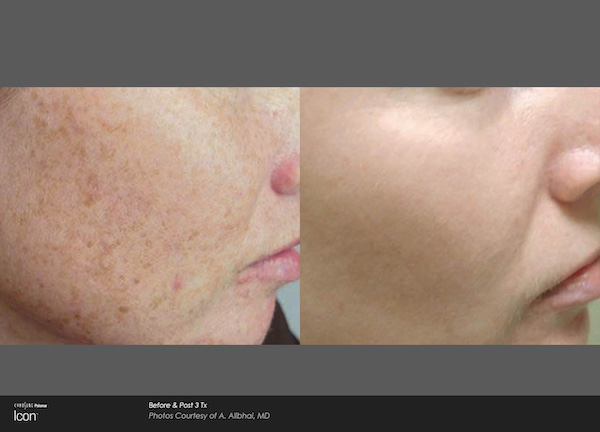
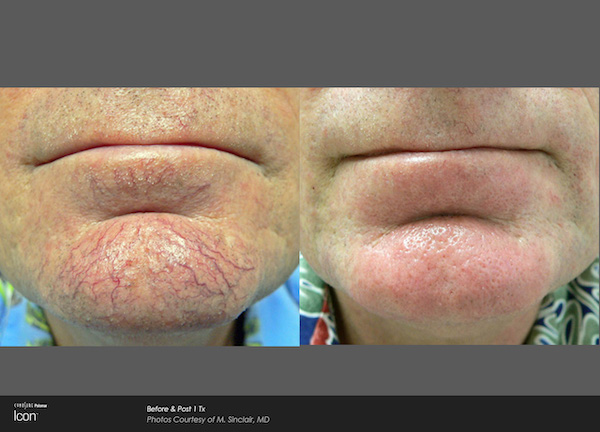
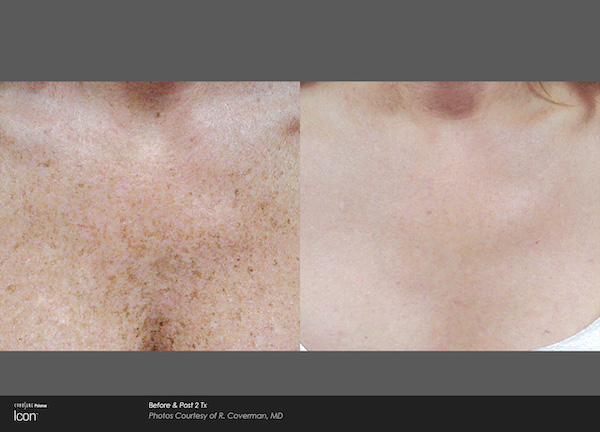
Average clearance of sun spots two months after a single treatment, in a study of 18 people, with nearly all of them seeing some fading. That is one session. Most courses here run three to five. [1]
Dr. Kilcline and her staff are amazing to work with…everyone is always so friendly!
The Coastal difference
The machine is the easy part
Every med spa on this coast has a light device, and most of them will book you without ever looking at your skin properly. The device is not the difference. Knowing which mark on your face is a sun spot, which is a broken vessel, which is something that needs a biopsy rather than a treatment, and what your skin tone means for the settings, is the difference. That assessment is a dermatologist’s job and it happens here before anything is scheduled.
Melasma is the clearest example of why that matters. IPL can lift it and we do use it for melasma, but melasma is not a spot you clear and forget. It is a condition that keeps being switched back on by sun, heat and hormones, and light on its own tends to buy you a few good months before it returns. Visible light has been shown to worsen melasma, and more so on skin that carries more pigment. [4] So when melasma is what you have, IPL goes into a plan rather than being sold as the plan: prescription-strength topical treatment doing the steady work, a daily sunscreen you actually wear, and light used to accelerate it. That is what the evidence supports and it is what we will recommend. [3] [5] A practice that sells you a course of IPL for melasma and nothing else has sold you a relapse.
The same honesty applies elsewhere. If your redness is heavy vessels rather than background flush, VBeam is the better instrument. Getting sent to the right treatment first time is cheaper than getting sold the wrong one.
Is it right for you?
IPL is probably a good fit if:
- You have brown spots, freckling or mottled sun damage on the face, chest, shoulders or hands
- You have background facial redness or small broken veins around the nose and cheeks
- You have melasma and want light as part of a plan that also includes topical treatment and daily sun protection
- Your skin has not seen recent sun and you can keep it that way through the course
- You can plan around a week or two of spots darkening and flaking
- You would rather do a short course than one heavy treatment
We will steer you somewhere else if:
- You are tanned or sunburned right now, from the sun, a bed or a bottle
- You want IPL alone for melasma, without the topical treatment and sun protection that hold it
- You are pregnant, or taking anything that makes you more sensitive to light
- You have recently finished a strong oral acne medication
- You have a pigmented spot that has not been examined yet, which comes first
Not sure which of those you are? That is exactly what the consultation is for, and it is why we look at your skin before booking this one.
What to expect afterward
For the first day your skin feels warm and looks flushed, like mild sunburn. Then the treated spots go darker, sometimes noticeably darker, before turning crisp and flaking away over three to fourteen days. Redness fades more gradually. Plan the week if you have something on.
In the first week, do
- Wear broad spectrum SPF 30 or higher every day without exception [2]
- Keep the area moisturized and let the spots flake off on their own
- Cool the skin gently if it feels hot on the first day
- Tell us if anything blisters or hurts rather than waiting
In the first week, don’t
- Pick, scrub or exfoliate the darkened spots
- Go back to retinoids or acids until we clear you
- Sit in the sun, use a sunbed or apply self-tanner
- Book a hot tub, sauna or heavy workout on the first day
Call us about blistering, real pain or any sign of infection. We would far rather hear from you.
Concerns treated
IPL clears what the sun and time have left on the surface: pigment and small vessels. Pick a concern to see how we approach it.
What treatment costs
IPL is priced per session and per area, and most people are booking a course of three to five rather than a single visit. We quote you the whole course at your consultation rather than one number that grows once you have started.
If a cheaper option or a different one would serve you better, that is the one you will be offered.
Treatment time
20 to 45 minutes, depending on the area
Downtime
A day of warmth and redness, then spots darken and flake for 3 to 14 days
Results appear
After each session, with the full change across the course
Results last
Years, with sun protection. New sun damage is new sun damage
IPL photofacial frequently asked questions
The single thing that decides whether your result holds. Broad spectrum, SPF 30 or higher, water resistant, every day. Nothing on this page outperforms that habit. [2]
Offered at
Offered in San Luis Obispo. Not yet available in Santa Maria.
Ready to start? Request your consultation
Fill out the form below, book online in Santa Maria (opens online scheduler), or give us a call. Cosmetic and aesthetic appointments need no referral. For medical dermatology in San Luis Obispo, we are accepting new patients by referral from your primary care physician; send the referral across and then use the same form. In Santa Maria, medical appointments are available without a referral for PPO patients, and for HMO patients we are in-network with Santa Maria Physician's Choice.
A consultation fee of $125 is due at the time of booking.
Sources and medical review
1. Bjerring P, Christiansen K. “Intense pulsed light source for treatment of small melanocytic nevi and solar lentigines.” *Journal of Cutaneous Laser Therapy.* 2000;2(4):177-181. Eighteen patients with solar lentigines received one treatment; average clearance 74.2% at two months, with pigment reduction in 96% of patients. Follow-up ran to two months only, so it supports no claim about how long the result lasts. Only the sun spot figure is used. PMID 11350673. https://pubmed.ncbi.nlm.nih.gov/11350673/ · Peer-Reviewed Study
2. American Academy of Dermatology Association. “How to select a sunscreen.” Broad spectrum, SPF 30 or higher, water resistant. https://www.aad.org/public/everyday-care/sun-protection/shade-clothing-sunscreen/how-to-select-sunscreen · Medical Organization
3. American Academy of Dermatology Association. “Skin conditions that lasers can treat.” Laser and light treatments are listed as useful to “reduce melasma,” alongside age spots, scars, spider veins and other concerns. https://www.aad.org/public/diseases/a-z/skin-conditions-lasers-treat · Medical Organization
4. American Academy of Dermatology Association. “Melasma: Self-care.” “Visible light has been shown to worsen melasma, especially for people with darker skin tones.” Melasma “may go away on its own” but “for some people, it can last for years,” and because sunlight triggers it, daily protection matters even on cloudy days. https://www.aad.org/public/diseases/a-z/melasma-self-care · Medical Organization
5. American Academy of Dermatology Association. “Melasma: Diagnosis and treatment.” A laser or light treatment “can improve results for patients who are already applying medication to their skin and protecting their skin from the sun,” and should only be performed by a board-certified dermatologist. https://www.aad.org/public/diseases/a-z/melasma-treatment · Medical Organization
Content on this page is for educational purposes and is not a substitute for professional medical advice. Mild redness and a warm, sunburned feeling for a day or two are expected, and treated spots commonly darken before flaking away over three to fourteen days. Blistering, burns, crusting, and lightening or darkening of the skin that can last months are recognized risks, and the risk is higher on tanned skin and on deeper skin tones. Melasma can recur after light-based treatment and can worsen without topical treatment and consistent sun protection. Machines of this class are cleared, not approved. This treatment is not suitable on skin that is tanned or sunburned, during pregnancy, alongside medications that increase sensitivity to sunlight, on or shortly after a strong oral acne medication, or where the skin is broken or infected. An unexamined pigmented spot is assessed by a dermatologist before any light-based treatment. Call us about blistering, real pain or signs of infection. Individual results may vary. A consultation fee of $125 is due at the time of booking.