

Psoriasis is a condition that causes the body to make new skin cells in days rather than weeks, so the cells pile up into thick, scaly patches called plaques. It is driven by the immune system, it is not contagious, and it is treated at Coastal Dermatology + Aesthetics in San Luis Obispo.
Skin built too fast
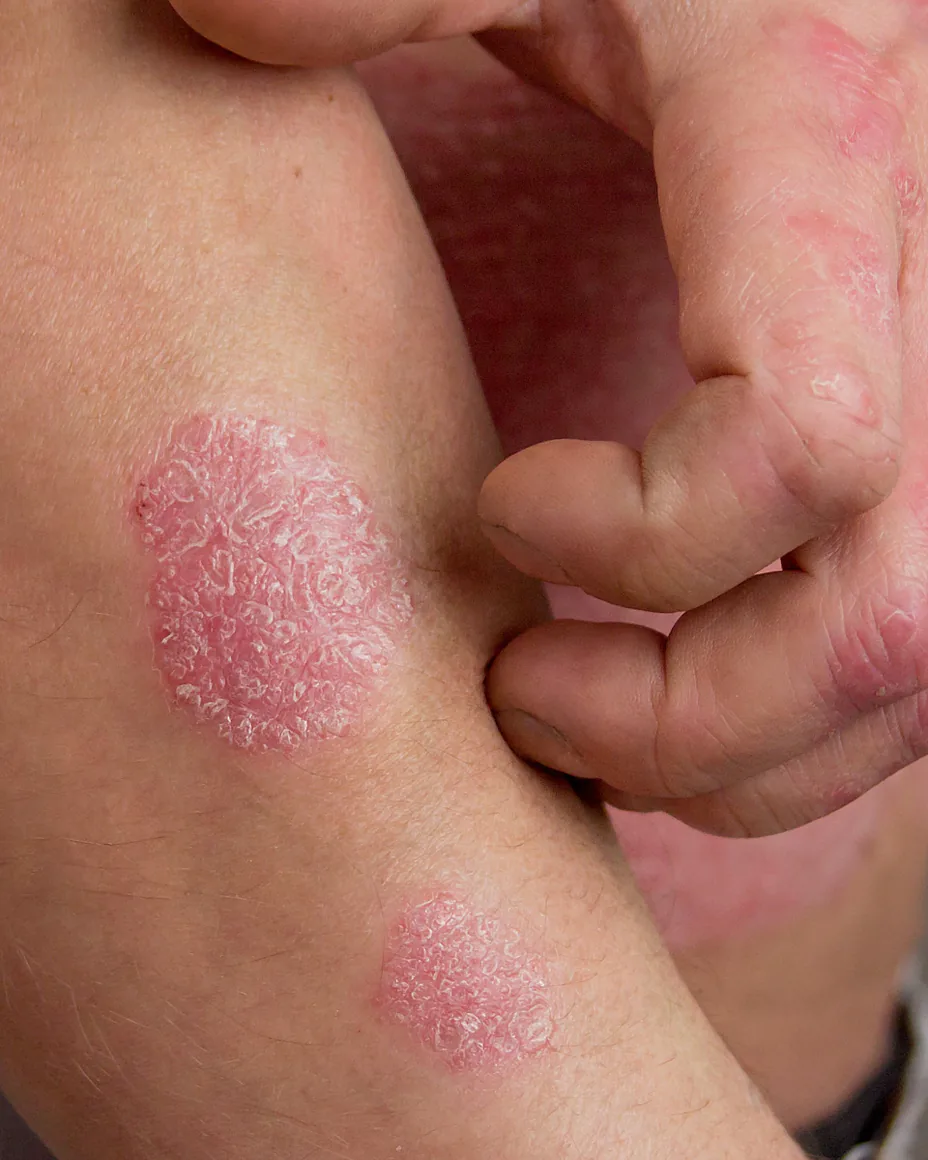
Psoriasis causes the body to make new skin cells in days rather than weeks. [1] As those cells pile up on the surface, you get thick, scaly patches called plaques. [1] Dry, thick and raised patches are the most common sign, they are often covered with a silvery-white coating called scale, and they tend to itch. [2]
Plaques can appear anywhere, and they turn up most often on the knees, elbows, lower back and scalp. [2] About 80 to 90 percent of people living with psoriasis get plaques, which is why plaque psoriasis is what most people mean by the word. [1] Other forms exist: small salmon-colored spots that can clear on their own in weeks or months, patches in skin folds, and forms involving pustules. [2] The nails are often involved too, with tiny dents, discoloration under the nail, or crumbling. [2]
It is not contagious and it is not caused by anything you did. [3] It is an immune condition: something goes wrong in the immune system, so T-cells attack the body’s own skin cells. [3] People with certain genes are more likely to get it, and having a parent, grandparent or sibling with psoriasis raises the odds. [3]
What people usually notice first
- Thick raised patches with a silvery-white scale, most often on knees, elbows, lower back or scalp [2]
- Itch, which tends to come with the plaques whatever their size [2]
- Flaking and itching on the scalp that shampoo does not settle
- Dents and changes in the nails, including discoloration or crumbling [2]
- Patches that flare and settle rather than staying the same
How fast psoriasis makes new skin cells. [1] The scale is not dryness and it is not poor hygiene. It is skin arriving faster than the surface can shed it, which is why moisturizer alone never gets there.
What causes it
The immune system, misdirected
Something goes wrong in the immune system, so T-cells attack the body’s own skin cells. [3] That is the engine, and it is why treatment that works on the immune side reaches psoriasis when nothing applied to the surface has.
Genes you were born with
People who have certain genes are more likely to get psoriasis, and having a parent, grandparent, brother or sister with it raises your risk. [3] It is also possible to carry those genes and never develop it at all. [3] Nothing about that is within your control, and none of it is a reason to look for something you did wrong.
What sets off a flare
Triggers do not cause psoriasis. They set it off in skin that already has it, and the recognized ones are specific: stress, a skin injury such as a cut or a bad sunburn, an infection such as strep throat, certain medications including lithium, prednisone and hydroxychloroquine, cold dry weather, tobacco and heavy drinking. [3] Working out which are yours is a normal part of the first visit.
Unlike chickenpox or a cold, you cannot catch psoriasis from someone. [3] It is worth saying plainly, because it is the thing people with visible plaques are most often made to feel self-conscious about.
Psoriasis looks different on darker skin, and that is why it gets missed
Almost every photograph of psoriasis you will find shows it on fair skin, as red or pink plaques with silvery-white scale. That is one presentation out of several, and if it is the only one you have seen, psoriasis on your own skin may not look like anything you recognize.
| Skin tone | How psoriasis tends to appear [4] |
|---|---|
| Fair skin | Red or pink plaques, and the scale is often silvery white |
| Hispanic skin | More likely salmon-colored plaques with silvery-white scale |
| African American skin | Often violet plaques with gray scale |
| Deeply pigmented skin | Can be dark brown and genuinely difficult to see |
There is a second half to this that matters just as much. When psoriasis clears on medium to deeply colored skin, you may be left with lighter or darker patches where the psoriasis used to be. [4] Those patches are not scars and they do eventually go, though clearing can take three to twelve months or longer. [4] Knowing that in advance is the difference between a treatment that looks like it failed and one that worked exactly as expected.
One practical consequence for treatment: light therapy can cause treated skin to tan or darken, and on skin of color it can make existing dark spots more noticeable. [4] That is a reason for the plan to be built around your skin rather than a reason to avoid treatment.
Where it shows up
| Area | What tends to happen there |
|---|---|
| Elbows and knees | The classic sites, and usually the first plaques people notice. [2] |
| Scalp | Thick scale along the hairline, frequently mistaken for flaking and itching on the scalp from another cause. [2] |
| Lower back | Common, easy to ignore, and often the plaque that has been there longest. [2] |
| Nails | Tiny dents, white, yellow or brown discoloration under the nail, crumbling or rough nails. [2] |
| Skin folds | Where plaques look smoother and shinier than elsewhere and get treated as a rash. [2] |
| Anywhere at all | Plaques can appear on any skin, which is why an examination covers more than the obvious places. [2] |
Dr. Kilcline is the best dermatologist! Best experience ever! Love her new beautiful facility & location.
The Coastal difference
There is no one best treatment, which is the whole reason to see somebody
There is no single best treatment for psoriasis and no one treatment that works for everybody. [5] That sounds like a caveat and it is actually the argument: the range of options is wide, they work differently for different people, and matching them is a clinical judgment rather than a product choice. A board-certified dermatologist examines your skin, nails and scalp, takes a small sample where the picture is not clear, and builds from there. [5]
The range runs from topical treatment through light therapy to medication that works throughout the body, and it has changed considerably in recent years. [5] Alongside whichever route suits you, a routine that does not fight your treatment matters more than people expect, because skin care plays a real part in reducing flares. [5] Both halves get planned in the same visit at our San Luis Obispo office.
Topical treatment, light therapy and medication that works throughout the body are all established options, and no single one works for everyone. [5] Which suits you is what the first appointment establishes.
When to see a dermatologist
Book an appointment if:
- You have thick, raised, scaly patches that have not cleared
- Scale on your scalp is not settling with anything you have tried
- Your nails have developed dents, discoloration, crumbling or lifting [2]
- Patches keep coming back in the same places
- Something has been treated as eczema or a rash without improving
- You have a family member with psoriasis and something on your skin looks similar
Especially worth booking if:
- You have a darker skin tone and something violet, gray-scaled or dark brown has appeared that nobody has named [4]
- You have joint pain or stiffness alongside skin changes, which is worth raising at the visit
- A flare followed an infection, a new medication or a stressful period
Psoriasis is diagnosed by a dermatologist examining your skin, nails and scalp, and sometimes by taking a small sample of skin. [5] There is nothing to prepare for.
Living with it
Most people who get psoriasis have it for life. [1] That sounds heavier than it is in practice: it is a condition that is managed, and managed well it spends most of its time quiet.
Worth doing
- Keep skin moisturized. Skin care plays a real part in reducing flares [5]
- Learn your own triggers rather than everybody’s. Keep a short note when a flare starts [3]
- Treat a cut or a sunburn promptly, since skin injury is a recognized trigger [3]
- Broad spectrum sunscreen, SPF 30 or higher, water resistant, every day [6]
- Give a treatment its full run before judging it, and say so if it is not working rather than stopping quietly
Worth knowing
- Cold, dry weather is a recognized trigger, which on the Central Coast makes winter the season to be deliberate about moisturizing [3]
- Tobacco and heavy drinking are both on the trigger list [3]
- Psoriasis is not contagious, to anyone, ever [3]
- On medium to deeply colored skin, lighter or darker patches after clearing are expected and temporary, and can take three to twelve months or longer to even out [4]
- Small salmon-colored spots can clear on their own in a few weeks or months without treatment [2]
Treatments we offer
Diagnosis, prescription treatment and a skin care routine that works with it rather than against it. Pick a treatment to see how it works.
What treatment costs
Diagnosis and treatment of psoriasis are medical care rather than a cosmetic service, and are handled differently from the aesthetic treatments on this site. Our office will go through what applies to you when you book.
Where a small sample of skin is taken, laboratory fees are billed separately by the laboratory that examines it, and we will tell you when a sample is being sent.
What it is
The body making new skin cells in days rather than weeks [1]
What you see
Thick, raised patches, usually with a silvery-white scale, that tend to itch [2]
Is it contagious
No. You cannot catch psoriasis from anyone [3]
How common
About 2% of people living in the United States have it [3]
Psoriasis frequently asked questions
Of people living in the United States have psoriasis. [3] It is common enough that a dermatology practice sees it constantly, and specific enough that it needs naming rather than treating as a rash.
Offered at
Ready to have it looked at? Request an appointment
Fill out the form below, book online in Santa Maria (opens online scheduler), or give us a call. Cosmetic and aesthetic appointments need no referral. For medical dermatology in San Luis Obispo, we are accepting new patients by referral from your primary care physician; send the referral across and then use the same form. In Santa Maria, medical appointments are available without a referral for PPO patients, and for HMO patients we are in-network with Santa Maria Physician's Choice.
Sources and medical review
1. American Academy of Dermatology Association. “Psoriasis: Overview.” States that “psoriasis is a condition that causes the body to make new skin cells in days rather than weeks,” that “as these cells pile up on the surface of the skin, you may see thick, scaly patches,” that those patches “are called plaques,” that “about 80% to 90% of people living with psoriasis get plaques,” and that “most people who get psoriasis have it for life.” https://www.aad.org/public/diseases/psoriasis/what/overview · Medical Organization
2. American Academy of Dermatology Association. “Psoriasis: Signs and symptoms.” States that “dry, thick, and raised patches on the skin are the most common sign of psoriasis,” that “these patches are often covered with a silvery-white coating called scale, and they tend to itch,” that plaques “can appear anywhere on the skin, but you’re most likely to find them on the: Knees, Elbows, Lower back, Scalp,” that “no matter the size, plaques tend to be itchy,” describes guttate psoriasis as “small and scaly,” “salmon-colored to pink” and “temporary, clearing in a few weeks or months without treatment,” and names nail signs including “tiny dents in your nails (called ‘nail pits’),” “white, yellow, or brown discoloration under one or more nails” and “crumbling, rough nails.” https://www.aad.org/public/diseases/psoriasis/what/symptoms · Medical Organization
3. American Academy of Dermatology Association. “Psoriasis: Causes.” States that “when a person has psoriasis, something goes wrong in the immune system, so T-cells also attack the body’s skin cells,” that “scientists have found that people who have certain genes are more likely to get psoriasis,” that “if a parent, grandparent, brother, or sister has psoriasis, you have a higher risk of getting it,” that “it’s possible to have genes that increase the risk of getting psoriasis and never develop psoriasis,” that “psoriasis is not contagious. Unlike chickenpox or a cold, you cannot catch psoriasis from someone,” that “about 2% of people living in the United States have this condition,” and names as triggers stress, skin injury such as a cut or bad sunburn, infection such as strep throat, some medications including lithium, prednisone and hydroxychloroquine, weather especially cold dry weather, tobacco, and heavy drinking. https://www.aad.org/public/diseases/psoriasis/what/causes · Medical Organization
4. American Academy of Dermatology Association. “Can you get psoriasis if you have skin of color?” States that “in fair-skinned people, psoriasis tends to be red or pink, and the scale is often silvery white,” that “a Hispanic person is more likely to have salmon-colored psoriasis and silvery-white scale,” that “in African Americans, the psoriasis often looks violet and the scale gray,” that “in dark skin, the psoriasis can also be dark brown and difficult to see,” that “when psoriasis clears on medium to darkly colored skin, you may see lighter or darker patches of skin where the psoriasis once was,” that “these patches are NOT scars and will eventually disappear,” that “clearing can take 3 to 12 months or longer,” that a dermatologist may call these patches “dyspigmentation,” and that light therapy “can cause the treated skin to tan or darken” and on skin of color “can also cause dark spots on your skin to become more noticeable.” https://www.aad.org/public/diseases/psoriasis/treatment/could-have/skin-color · Medical Organization
5. American Academy of Dermatology Association. “Psoriasis: Diagnosis and treatment.” States that “to diagnose psoriasis, a dermatologist will examine your skin, nails, and scalp for signs of this condition,” that “sometimes, a dermatologist will remove a small piece of skin. This is called a skin biopsy,” that “there is no one best treatment for psoriasis, and no one treatment works for everyone,” that “light therapy: this treatment uses special light bulbs or lasers to treat psoriasis,” that “skin care also plays an important role in treating psoriasis because it can help reduce flare-ups,” and names topical corticosteroids, synthetic vitamin D, topical calcineurin inhibitors, salicylic acid, tazarotene, roflumilast, tapinarof and coal tar among topical options, and apremilast, biologics and biosimilars, cyclosporine, methotrexate, acitretin and TYK2 inhibitors among treatments that work throughout the body. https://www.aad.org/public/diseases/psoriasis/treatment/treatment · Medical Organization
6. American Academy of Dermatology Association. “How to select a sunscreen.” Broad spectrum, SPF 30 or higher, water resistant, reapplied every two hours outdoors and after swimming or sweating. https://www.aad.org/public/everyday-care/sun-protection/shade-clothing-sunscreen/how-to-select-sunscreen · Medical Organization
Content on this page is for educational purposes and is not a substitute for professional medical advice, diagnosis or treatment. Psoriasis is diagnosed by examination, sometimes with a skin biopsy, and several conditions can look similar. It is a long-term condition that is managed rather than cured, and response to treatment varies considerably from person to person. Prescription and light-based treatments each carry their own risks, which are discussed individually before anything is started. Individual results may vary.