

Atopic dermatitis, also called eczema, is a common chronic condition that causes itchy, dry and inflamed skin. It usually begins in childhood but can start at any age, and it is not contagious. It is diagnosed and treated at Coastal Dermatology + Aesthetics in San Luis Obispo.
A barrier problem, not a hygiene problem
Atopic dermatitis is a common condition that causes itchy, dry and inflamed skin. [1] It usually begins in childhood but can start at any age, and it is chronic, which means it lasts a long time. [1] It is not contagious and cannot spread from person to person. [1]
What sits underneath it is a skin barrier that does not seal properly. That lets too much moisture escape, which is the dryness. It lets everyday things from dust mites to fragrance get inside, which is the inflammation. And it lets germs in, which is why infection is a real complication rather than a rare one. [3] Understanding that changes what treatment looks like: repairing and protecting the barrier is not an add-on to the medication, it is half the treatment.
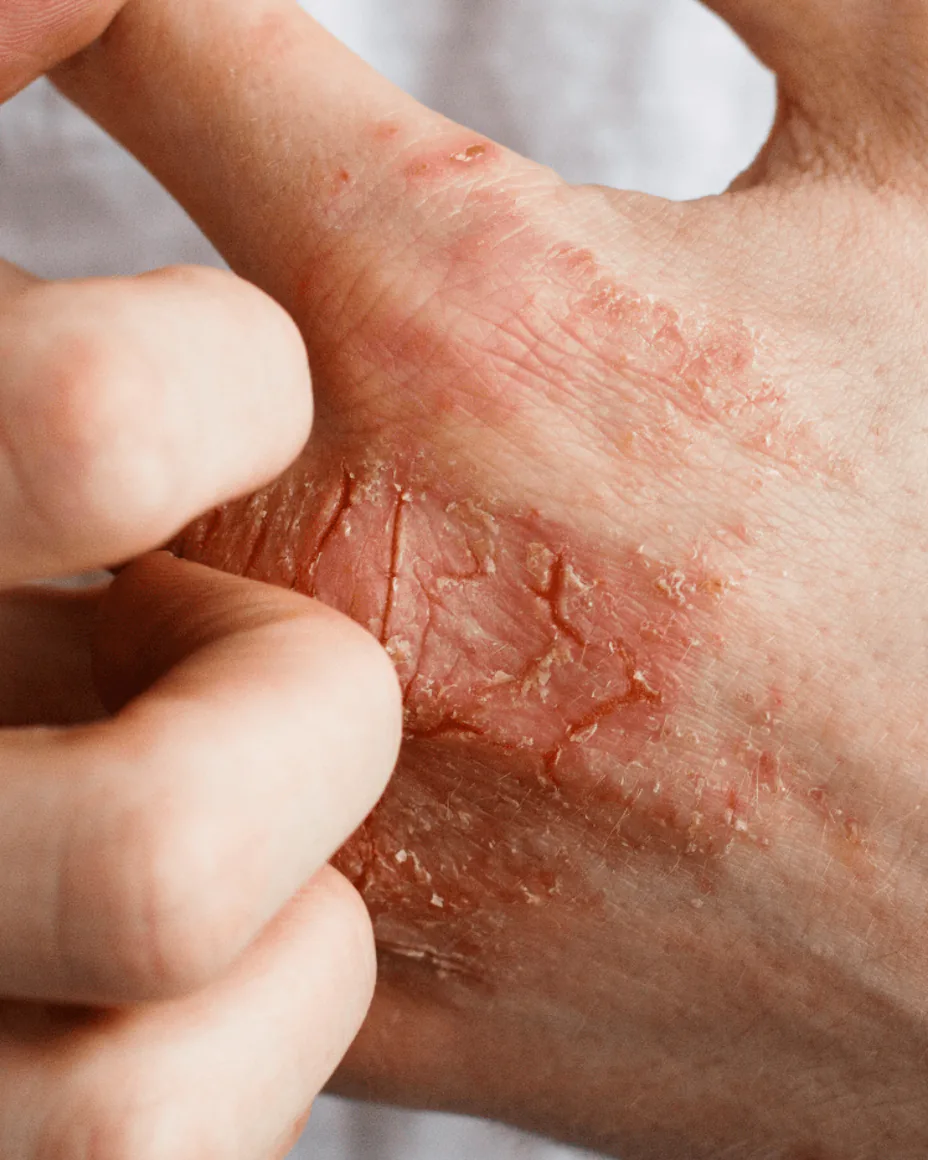
The itch is the part that does the damage. Scratching breaks the barrier further, which produces more inflammation, which produces more itch. Over time skin that has been through that cycle becomes thickened, scaly and leathery, and can crack. [2] Breaking the cycle early is worth more than treating the result of it.
What it looks like [2]
- Itchy skin, often intensely so, which is the defining feature
- Dry, scaly areas
- A red rash, especially on lighter skin tones
- Small, rough bumps, which are more common on darker skin tones
- Skin that feels warm and may be swollen
- Over time, skin that has become thickened, scaly, leathery or cracked
What is actually not working. A barrier that lets moisture out and irritants in produces the dryness, the inflammation and the infections. [3] Which is why moisturizing is treatment here rather than aftercare.
What causes it
Genes, the immune system, and what touches your skin
All three play a part. [3] The clearest single pattern is family: many people who develop atopic dermatitis have one or more blood relatives with eczema, asthma or hay fever, and studies have found that to be true for 70 percent of patients. [3] That is not something you caused and it is not something to correct.
What sets off a flare
The common triggers are ordinary: skin care products, weather that is either cold or hot, wool clothing, stress, fragrance, perfume and harsh detergents. [4] Yours will be a shorter list than that. Going through what you actually use is a normal part of the first visit and it is frequently the cheapest change available.
Where you live, and the Central Coast version of it
People living in a city are more likely than people in a rural area to develop atopic dermatitis, and living in a dry climate or further from the equator may raise the risk too. [3] Locally the pattern people notice most is the swing: cool damp mornings and dry warm afternoons in the same day, and heating in winter, all of which pull moisture out of a barrier that was already leaking.
Of patients have one or more blood relatives with atopic dermatitis or an allergic disease such as asthma or hay fever. [3] It runs in families, which means nothing you did started it.
It looks different at different ages, and on different skin
Eczema is one condition that presents in several ways, and the two axes that matter most are age and skin tone. This is the table people need and almost nobody publishes.
| Where it sits | What it looks like | |
|---|---|---|
| Babies and young children | Cheeks, forehead or scalp [2] | On lighter skin, a red rash with bumps and swelling that may ooze or crust. On darker skin tones, babies are more likely to develop small bumps, extremely dry skin, and dark brown, gray or purple skin where they have it [2] |
| Children | Creases of the elbows and knees on lighter skin tones; children with brown or black skin are more likely than white children to have it on the trunk [2] | On darker skin tones, several bumps with or without redness, and darker areas of skin [2] |
| Adults | More likely on the hands, and around the eyes, than in children [2] | Often thickened, scaly and leathery from years of the itch and scratch cycle, and prone to cracking [2] |
| Any age, darker skin | Anywhere the above applies | Dark brown, purple or grayish areas rather than red. Bumps tend to be gray to violet-brown [2] |
The reason this matters is diagnostic. Eczema described as “a red rash” is eczema described on fair skin. On darker skin the redness may not read at all, and what shows instead is bumps and a change in tone. That is why it gets missed, treated as something else, or dismissed as dry skin for years.
It is also why Black children in the United States are twice as likely as white children to develop atopic dermatitis and still frequently arrive without a diagnosis. [3] Naming it correctly is the first thing a visit does.
Where it shows up
| Area | Who tends to get it there |
|---|---|
| Cheeks, forehead and scalp | Babies and young children. [2] |
| Creases of the elbows and knees | Children, particularly on lighter skin tones. [2] |
| Trunk | More likely in children with brown or black skin. [2] |
| Hands | More likely in adults than in children, and often the version that follows people to work. [2] |
| Around the eyes | More likely in adults, and one of the hardest areas to treat gently. [2] |
| Neck and behind the ears | Frequently affected, frequently missed, and where a scalp that flakes and itches can be part of the same picture. |
Services are prompt, friendly, professional and most of all comfortable…it was an extraordinary experience.
The Coastal difference
The list of what works has changed, and most people are on the old list
Eczema treatment looked one way for decades and it does not look that way now. Alongside topical steroids there are non-steroid creams, and for people whose eczema has not responded there are injectable and oral treatments that did not exist a few years ago. [4] Somebody managing eczema with the same drugstore routine they were given years ago is very likely working from an out-of-date map, and that is the single most common reason a first appointment here changes something.
The other half is the barrier. Prescription treatment settles a flare; a short, gentle routine and a barrier-first routine are what keep the next one further away. Going through what you already use, and often removing more than we add, is part of the visit rather than a separate consultation. And where the picture looks more like something your skin touched or like psoriasis, naming that correctly is worth more than any product.
Non-steroid creams, and injectable and oral treatments for eczema that has not responded to topicals, are all established options now. [4] If your plan is several years old, it is worth a fresh look.
When to see a dermatologist
Book an appointment if:
- Itchy, dry or inflamed skin is not settling with what you have been using
- The itch is affecting sleep, which is the sign most worth acting on
- Skin has become thickened, leathery or is cracking [2]
- A child has a rash on the cheeks, in the elbow creases, or across the trunk that keeps returning
- You are using a steroid cream continuously rather than in courses
- Your routine has not been reviewed in several years
Sooner rather than later if:
- Skin looks infected: weeping, crusting, spreading redness, or feeling unwell alongside it
- A flare followed a new medication, and you are unsure whether the two are connected
Diagnosis is by examination and questions, sometimes with a small sample of skin to confirm. [4] Bring what you currently use, including anything you have tried and abandoned.
Living with it
This condition cannot be cured, and proper treatment can control it. [1] Most of that control happens between appointments.
Worth doing
- Moisturize, generously and often, on skin that is still damp after bathing. Being gentle with your skin is half the plan [4]
- Cut the routine back to what is necessary while skin is flared, and add things back one at a time
- Fragrance-free, and check the labels rather than the front of the bottle
- Lukewarm water rather than hot, and pat dry rather than rub
- Keep a short note of what preceded a flare. Two weeks finds most triggers [4]
Worth knowing
- Atopic dermatitis is not contagious and cannot be spread to anyone [1]
- Treatment can lead to clear or almost clear skin, and it does not cure the underlying condition [1]
- Wool, harsh detergents, fragrance, stress and weather at either extreme are the common triggers [4]
- Scratching feeds the cycle, so treating the itch is treating the eczema rather than treating a symptom
- Infection is a genuine complication of a broken barrier rather than a rare event, which is why weeping or crusting skin gets seen promptly [3]
Treatments we offer
Diagnosis, prescription treatment, and the routine that holds the result between flares. Pick a treatment to see how it works.
What treatment costs
Diagnosis and treatment of atopic dermatitis are medical care rather than a cosmetic service, and are handled differently from the aesthetic treatments on this site. Our office will go through what applies to you when you book.
Where a small sample of skin is taken, laboratory fees are billed separately by the laboratory that examines it, and we will tell you when a sample is being sent.
What it is
A common condition causing itchy, dry and inflamed skin [1]
When it starts
Usually in childhood, often between 2 months and 5 years, but it can start at any age [1] [3]
Is it contagious
No. It cannot spread from person to person [1]
Family pattern
Many people have a blood relative with eczema, asthma or hay fever. Studies put that at 70% [3]
Eczema frequently asked questions
Applying moisturizer and being gentle with your skin are named alongside medication rather than after it. [4] On a barrier condition, that is treatment rather than aftercare.
Offered at
Ready to get it under control? Request an appointment
Fill out the form below, book online in Santa Maria (opens online scheduler), or give us a call. Cosmetic and aesthetic appointments need no referral. For medical dermatology, we are accepting new patients by referral from your primary care physician; send the referral across and then use the same form.
Sources and medical review
1. American Academy of Dermatology Association. “Eczema types: Atopic dermatitis overview.” States that “also called eczema, atopic dermatitis is a common condition that causes itchy, dry, and inflamed skin,” that “it usually begins in childhood but can start at any age,” that “atopic dermatitis is a chronic disease, which means it can last a long time,” that “no, atopic dermatitis is not contagious, so this condition cannot spread from person to person,” that “at this time, atopic dermatitis cannot be cured. However, treatment can ease symptoms and lead to clearer, if not completely clear, skin,” and that “this condition cannot be cured, but proper treatment can control it.” https://www.aad.org/public/diseases/eczema/types/atopic-dermatitis · Medical Organization
2. American Academy of Dermatology Association. “Eczema types: Atopic dermatitis signs and symptoms.” Names itchy skin, dry scaly areas, a red rash “especially on lighter skin tones,” “small, rough bumps (more common in darker skin tones),” skin that “feels warm and maybe swollen,” and over time skin that is “thickened, scaly, and leathery” and “cracked.” States that “babies with darker skin tones are more likely to develop small bumps, extremely dry skin, and dark brown, gray, or purple skin where they have atopic dermatitis,” that “children with darker skin tones may have several bumps with or without redness and darker areas of skin,” that “on darker skin tones, the bumps tend to be gray to violet-brown in color,” that “children with brown or black skin are more likely than white children to have atopic dermatitis on their trunk,” that “babies and young children often develop it on their cheeks, forehead, or scalp,” that “children with lighter skin tones often develop an itchy rash in the creases of their elbows,” and that “adults are more likely than children to have atopic dermatitis on their hands” and “around their eyes.” https://www.aad.org/public/diseases/eczema/types/atopic-dermatitis/symptoms · Medical Organization
3. American Academy of Dermatology Association. “Eczema types: Atopic dermatitis causes.” States that genes, the immune system and what touches the skin all play a role, that a compromised barrier allows “too much moisture to escape from the skin, causing dryness,” allows “everyday things in the environment from dust mites to fragrances to get inside the protective barrier, leading to inflammation,” and allows “germs like virus and bacteria to get inside the barrier, which can lead to an infection.” States that “many people who develop atopic dermatitis have one or more blood relatives with atopic dermatitis or an allergic disease like asthma or hay fever” and that “studies have found this to be true for 70% of patients,” that atopic dermatitis “often appears between 2 months and 5 years of age,” that “in the United States, Black children are twice as likely as white children to develop atopic dermatitis,” and that “people living in a city are more likely than people living in a rural area to develop atopic dermatitis” and that “living in a dry climate or far from the equator, where it’s cooler, may also increase your risk.” https://www.aad.org/public/diseases/eczema/types/atopic-dermatitis/causes · Medical Organization
4. American Academy of Dermatology Association. “Eczema types: Atopic dermatitis diagnosis and treatment.” States that “to diagnose atopic dermatitis, also called eczema, a board-certified dermatologist carefully examines your (or your child’s) skin and asks questions,” that a skin biopsy may be used to confirm, that “common triggers include skin care products, weather (cold or hot), wool clothing, stress, fragrance, perfumes, and harsh detergents,” and names topical corticosteroids, non-steroid topical options, light therapy, wet wrap therapy, and injectable and oral treatments for disease that has not responded to topical treatment. Names “applying moisturizer” and “being gentle with your skin” as self-care. https://www.aad.org/public/diseases/eczema/types/atopic-dermatitis/treatment · Medical Organization
Content on this page is for educational purposes and is not a substitute for professional medical advice, diagnosis or treatment. Atopic dermatitis is diagnosed by examination, and several conditions can look similar. It is a chronic condition that is managed rather than cured, and response to treatment varies from person to person. Prescription treatments, including topical, oral and injectable options, each carry their own risks, which are discussed individually before anything is started. Skin affected by eczema is more prone to infection; weeping, crusting or spreading redness should be seen promptly. Individual results may vary.