

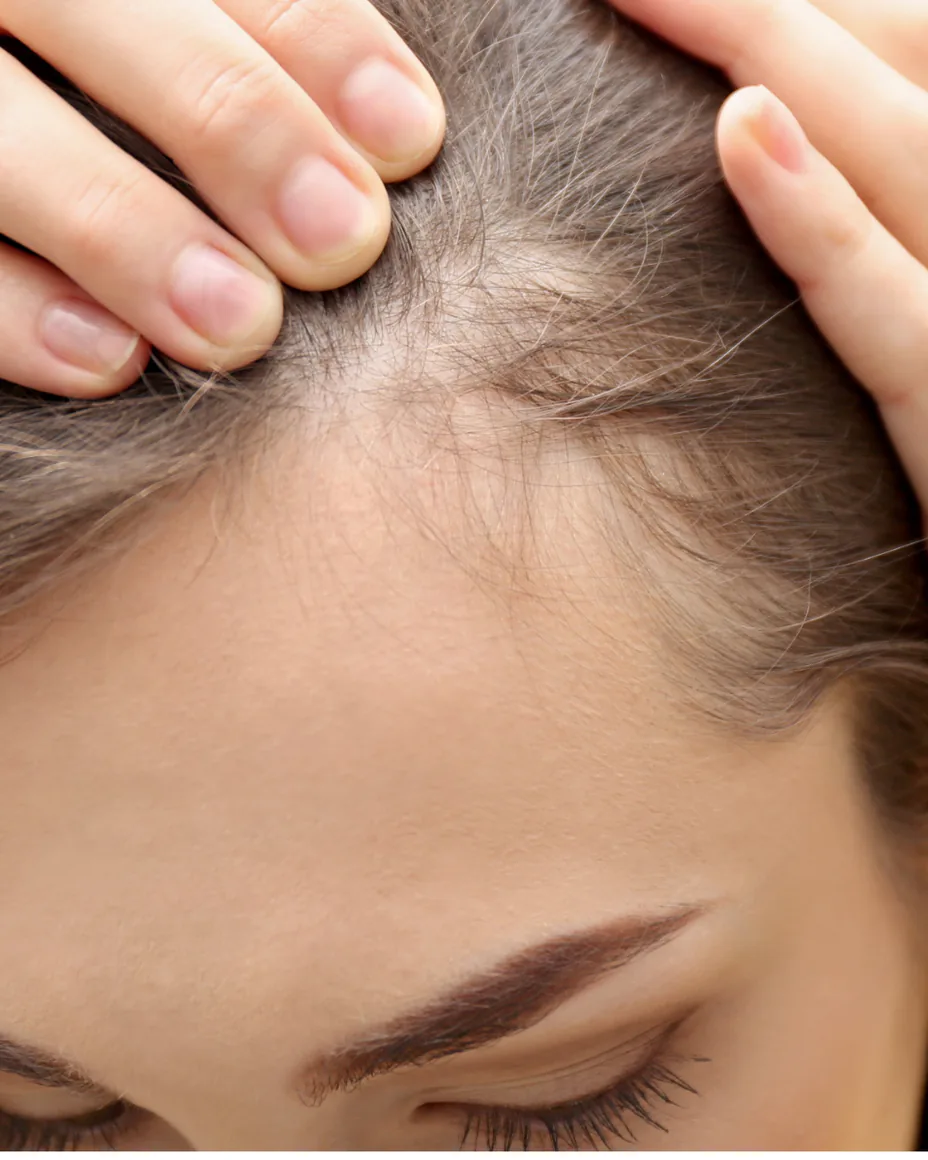
Alopecia areata is an autoimmune disease that causes hair loss, usually beginning as a round or oval smooth bald patch on the scalp or beard area, though it can occur anywhere on the body. Hair can regrow. It is diagnosed and treated at Coastal Dermatology + Aesthetics in San Luis Obispo.
The immune system, not the hair
Alopecia areata is an autoimmune disease. [3] That means the immune system mistakes a part of your body as foreign and attacks it, and in this case it attacks hair follicles, and sometimes nails. [3] The hair itself is fine. What has changed is the environment around it.
It causes sudden hair loss that often begins as a round or oval, smooth balding patch. [2] Most people lose hair on the scalp or in the beard area, and it can occur anywhere on the body. [1] It usually begins in children and young adults and can start at any age. [1] People of all skin tones and genders get it. [2]
Some people notice itching, tingling or a burning sensation where hair loss is about to begin or has already occurred. [2] About 10 to 20 percent of people with alopecia areata see changes in the nails, most commonly tiny dents. [2] Where more hair is involved, it has its own names: complete loss on the scalp, loss of all body hair, or a band of loss around the back and sides of the head. [2]
What distinguishes it from ordinary thinning
- The patch is round or oval, and the skin inside it is smooth rather than scaly
- It arrived suddenly rather than gradually
- The hair around the edge is unaffected rather than thinning
- It can appear in the beard, the eyebrows or the lashes as well as the scalp [2]
- The gradual, inherited kind of thinning behaves nothing like this and is a different page
What alopecia areata actually is. The immune system mistakes hair follicles as foreign and attacks them. [3] Nothing you did started it, and nothing you eat or apply is the reason it happened.
What causes it
An immune system attacking the wrong target
The immune system mistakenly attacks hair follicles, and sometimes nails. [3] Why it starts doing that in one person and not another is not fully understood, and it is not caused by anything a patient did.
What runs in families
Alopecia areata can run in families, and people who develop it at an early age often have a blood relative who has the disease. [3] It also travels with other autoimmune conditions: psoriasis, thyroid disease and vitiligo are named alongside it, and there is an increased association with asthma, hay fever and eczema. [3] That is a reason to mention your full history at the visit, not a reason to expect any of them.
What is a trigger and what is not
Some people remember intense stress or a crisis before seeing patchy hair loss. Those are not causes, and they may increase the risk of the immune system attacking the follicles. [3] Smoking over a long period is also named. [3] The distinction matters, because people arrive at this page carrying a lot of blame that the condition does not support.
Of people treated with corticosteroid injections for patchy alopecia areata had at least half of their hair regrow within 12 weeks. [4] Results can begin to appear within three months of the first injection. [4]
What to expect, honestly, because the course is unpredictable
This is the part most pages skip, and skipping it is why people feel blindsided. Alopecia areata does not follow one path, and knowing the range in advance is worth more than any single reassurance.
| What can happen | How common, in the terms available |
|---|---|
| Hair regrows on its own, without treatment | Happens “for many people” [1] |
| Hair regrows and never falls out again | Happens to “some people” [1] |
| Hair regrows and then falls out again, in cycles | “More often” than the single-episode course [1] |
| Hair does not regrow | Happens “sometimes” [1] |
| Hair loss extends to the whole scalp, or the whole body | Named as recognized patterns, with no frequency published [2] |
Three things are true at once, and all three belong in the same paragraph. Hair can grow back. Relapse is common. And at this time alopecia areata cannot be cured, though treatment can help people regrow their hair. [4] Anyone telling you only the first of those is selling something, and anyone telling you only the last is doing you a disservice.
What follows practically is that treatment is worth starting and worth judging on a realistic clock, and that a plan includes what happens if hair falls out again. That conversation is a normal part of the visit rather than bad news delivered later.
Where it shows up
| Area | What tends to happen there |
|---|---|
| Scalp | The most common site, usually starting as one round or oval smooth patch. [2] |
| Beard area | The other common site, and frequently the first place men notice it. [1] |
| Eyebrows and eyelashes | Loss here has its own practical consequences and its own options. [4] |
| Back and sides of the head | Where a band of loss can extend toward the temples. [2] |
| Nails | Tiny dents most commonly, and also ridges, roughness or brittleness. [2] |
| Anywhere on the body | Hair loss can occur anywhere hair grows. [1] |
Always have had a great experience here.
The Coastal difference
Naming it correctly is most of the work
Patchy hair loss gets treated as stress, as a vitamin deficiency, as a shampoo problem and as the gradual, inherited kind of thinning for months before anybody looks at it properly. A board-certified dermatologist examines the scalp and the nails, often with a magnifier, and where the picture is not clear adds a small sample or blood work, including thyroid testing. [4] That is a short appointment and it changes everything downstream, because almost nothing sold for hair does anything at all for an autoimmune condition.
The treatment range is wider than most people know and it depends on how much hair is involved. For one or two patches there is watchful waiting, topical treatment, and corticosteroid injections, where more than 80 percent of people treated had at least half their hair regrow within 12 weeks. [4] For more extensive loss there is contact immunotherapy and a class of oral medication approved specifically for severe alopecia areata. [4] Which route fits is a clinical judgment, and it is the reason to be assessed rather than to keep trying things.
How often corticosteroid injections are given for patchy alopecia areata, with results that can begin to appear within three months of the first one. [4] A course rather than a single appointment.
When to see a dermatologist
Book an appointment if:
- A round or oval patch of hair loss has appeared, on the scalp or in the beard
- The skin in the patch is smooth rather than flaky or inflamed
- Hair loss arrived suddenly rather than gradually
- You have noticed tingling, itching or burning where hair is being lost [2]
- Your eyebrows or lashes are thinning
- Your nails have developed tiny dents alongside hair loss [2]
Worth raising at the same visit:
- Any personal or family history of thyroid disease, vitiligo, psoriasis, asthma, hay fever or eczema [3]
- Whether hair has fallen out and regrown before, which shapes the plan
- Anything about a scalp that flakes and itches, which points at a different condition
Diagnosis is by examining the scalp and nails, often with a magnifier, sometimes with a small sample or blood work. [4] Nothing about it requires preparation.
Living with it
This is a condition that affects how you look and how you feel about being seen, and both are legitimate reasons to treat it.
Worth doing
- A soft-bristled brush, a wide-tooth comb, and loose hairstyles rather than tight ones [5]
- Air-dry where you can, rather than blow-drying, and avoid harsh chemicals [5]
- Sunscreen on any exposed scalp, broad spectrum, SPF 30 or higher, water resistant [5]
- A wide-brimmed hat, or a wig, for scalp protection and for comfort [5]
- Where brows or lashes are affected, glasses and a hat do a practical job that nothing else does [5]
- Managing stress with something that works for you may help reduce cycles of hair loss [5]
Worth knowing
- Hair can regrow, including after a long time, and relapse is common. Both are normal [1]
- The condition is associated with a higher risk of thyroid disease, which is worth mentioning to your regular doctor [5]
- If nasal hair has been lost, a little petroleum jelly inside the nostrils does more than people expect [5]
- The National Alopecia Areata Foundation is a genuine support resource and is worth knowing about [5]
- Nothing sold over the counter for general hair thinning is aimed at this condition
Treatments we offer
Diagnosis first, then a plan sized to how much hair is involved and how long it has been going on. Pick a treatment to see how it works.
What treatment costs
Diagnosis and treatment of alopecia areata are medical care rather than a cosmetic service, and are handled differently from the aesthetic treatments on this site. Our office will go through what applies to you when you book.
Where blood work or a small sample is sent for testing, laboratory fees are billed separately by the laboratory, and we will tell you when anything is being sent.
What it is
An autoimmune disease that causes hair loss [1]
What it looks like
Sudden loss that often begins as a round or oval, smooth balding patch [2]
Who gets it
Usually begins in children and young adults, and can start at any age. People of all skin tones and genders [1] [2]
Can hair grow back
Yes. Some people regrow it and never have another episode [1]
Alopecia areata frequently asked questions
Of people with alopecia areata see changes to their nails, and tiny dents are the most common. [2] It is a useful sign at diagnosis and one most people have never connected to their hair.
Offered at
Ready to have it looked at? Request an appointment
Fill out the form below, book online in Santa Maria (opens online scheduler), or give us a call. Cosmetic and aesthetic appointments need no referral. For medical dermatology, we are accepting new patients by referral from your primary care physician; send the referral across and then use the same form.
Sources and medical review
1. American Academy of Dermatology Association. “Alopecia areata: Overview.” States that “alopecia areata is a disease that causes hair loss. Most people lose hair on their scalp or beard area, but hair loss can occur anywhere on your body,” that “this type of hair loss usually begins in children and young adults, but it can start at any age,” that “yes, hair can grow back. Some people who lose their hair, regrow it, and never have another episode,” that “more often, people lose their hair, only to see it regrow and fall out again,” and that “for many people, their hair regrows on its own without treatment” while “sometimes, hair doesn’t regrow.” https://www.aad.org/public/diseases/hair-loss/types/alopecia · Medical Organization
2. American Academy of Dermatology Association. “Alopecia areata: Signs and symptoms.” States that the disease “causes sudden hair loss, which often begins as a round or oval, smooth balding patch,” that “people of all skin tones and genders get alopecia areata,” that “about 10% to 20% of people who have alopecia areata see changes to their nails. Tiny dents are the most common,” and that some people notice “itching, tingling, or a burning sensation where hair loss will soon begin or has already occurred.” Describes alopecia totalis as “complete loss of hair on the scalp,” alopecia universalis where “some people lose all the hair on their body,” and ophiasis as “a band or strip of bald skin on their scalp” that “usually appears at the back of the head and can extend to the temples.” https://www.aad.org/public/diseases/hair-loss/types/alopecia/symptoms · Medical Organization
3. American Academy of Dermatology Association. “Alopecia areata: Causes.” States that “alopecia areata is an autoimmune disease. This type of disease develops when your immune system mistakes a part of your body as foreign and attacks,” that the immune system “mistakenly attacks hair follicles (where hair grows) and sometimes your nails,” that “alopecia areata can run in families. People who develop alopecia areata at any early age often have a blood relative who has the disease,” names psoriasis, thyroid disease and vitiligo among associated autoimmune conditions along with an increased risk alongside asthma, hay fever and atopic dermatitis, and states that “some people remember experiencing intense stress or a crisis before seeing patchy hair loss. While these aren’t causes, they may increase the risk of your immune system attacking your hair follicles.” https://www.aad.org/public/diseases/hair-loss/types/alopecia/causes · Medical Organization
4. American Academy of Dermatology Association. “Alopecia areata: Diagnosis and treatment.” Describes diagnosis by scalp and nail examination, often with a dermatoscope, sometimes with a biopsy, blood tests for thyroid function and family history questions. States that for patchy alopecia areata treated with corticosteroid injections given every 4 to 6 weeks, “more than 80% who were treated with these injections had at least half of their hair regrow within 12 weeks,” with results possible “within 3 months of getting the first injection,” that success with contact immunotherapy “ranges from 17% to 75%,” and that “at this time, alopecia areata cannot be cured. However, treatment can help people regrow their hair.” Names topical corticosteroids, minoxidil, anthralin, contact immunotherapy and oral medications approved for severe alopecia areata. https://www.aad.org/public/diseases/hair-loss/types/alopecia/treatment · Medical Organization
5. American Academy of Dermatology Association. “Alopecia areata: Self-care.” Recommends a soft-bristled brush and wide-tooth comb, avoiding harsh chemicals, air-drying rather than blow-drying, loose hairstyles, and to “apply sunscreen to your scalp. Use a sunscreen that offers SPF 30 or higher, broad-spectrum protection, and water resistance.” Names a wide-brimmed hat or wig, hats, sweatbands and glasses where brows or lashes are lost, and petroleum jelly inside the nostrils where nasal hair is lost. States that “learning how to manage your stress with a technique that works for you, such as meditation or yoga, may help reduce cycles of hair loss,” that people with alopecia areata “have higher risk for thyroid disease and other conditions,” and names the National Alopecia Areata Foundation as a support resource. https://www.aad.org/public/diseases/hair-loss/types/alopecia/self-care · Medical Organization
Content on this page is for educational purposes and is not a substitute for professional medical advice, diagnosis or treatment. Several conditions cause hair loss and they are treated differently; diagnosis is made by examination and sometimes by biopsy or blood testing. Alopecia areata follows an unpredictable course, regrowth is not guaranteed, and hair that regrows may fall out again. It cannot currently be cured. The figures on this page describe results reported in groups of patients and do not predict any individual outcome. Corticosteroid injections, immunotherapy and oral medications each carry their own risks, which are discussed individually before anything is started. Individual results may vary.