

Shingles is a painful, blistering rash caused by the varicella-zoster virus, the same virus that causes chickenpox, reactivating years later. It usually appears as a band on one side of the body. It is diagnosed and treated at Coastal Dermatology + Aesthetics in San Luis Obispo.
An old virus waking up
If you had chickenpox, the virus that caused it is still inside your body. When the chickenpox cleared, the virus moved from your skin to your nerves, where it went dormant. [3] Shingles is that virus waking up. Most people who get it develop a painful, blistering rash. [1]
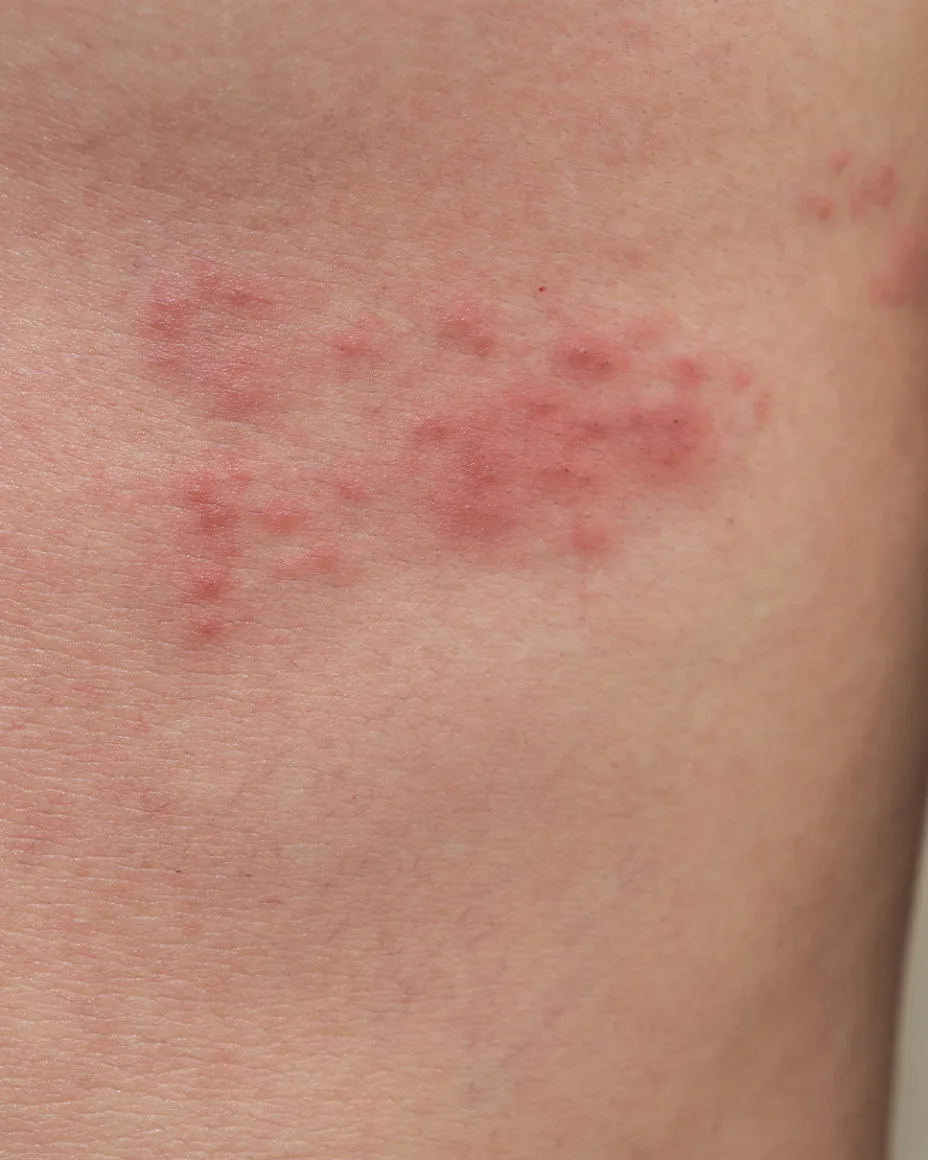
The rash appears on one side of the body only, most often on the torso, in a band. [2] That one-sided band is the most recognizable thing about it. For one to two days before the rash appears, you may have pain, burning or tingling in the area, which is why people often describe a strange sensation before there was anything to see. [2]
On lighter skin tones the bumps tend to be red. On darker skin tones you may see grayish, pink, dark brown or purplish bumps rather than red ones. [2] That is worth knowing, because a rash that does not look like the pictures still needs the same two-to-three-day response.
What it looks and feels like
- Pain, burning or tingling for one to two days before anything appears [2]
- A painful, blistering rash on one side of the body, often on the torso [2]
- A band-like pattern, which is where it gets the name shingles band [2]
- Blisters that clear in seven to ten days [4]
- A rash that goes completely within two to four weeks [2] [4]
The window that matters. Starting prescription medication within two to three days of the rash appearing can dramatically reduce symptoms, shorten how long you have shingles, and lower the risk of other problems. [1]
Who gets it, and why
Having had chickenpox, which is almost everybody
The virus stays in your nerves after chickenpox clears. [3] That is not unusual; it is the ordinary outcome of a childhood illness that most adults born before 1980 had. Shingles is that dormant virus reactivating, and it is rare to get shingles before the age of 40, with risk rising through the fifties. [3]
Anything that lowers immune defenses
Leukemia and lymphoma, HIV, having had an organ transplant and taking medication to prevent rejection, ongoing chemotherapy, and severe psoriasis or advanced psoriatic arthritis are all named as raising the risk. [3] If any of those apply to you, the two-to-three-day window matters even more.
The vaccine question, which belongs with your doctor
There is a shingles vaccine and it is recommended for healthy adults aged 50 and over. [3] In studies it reduced the risk of developing shingles by 96.6 percent in people aged 50 to 59, 97.4 percent in people aged 60 to 69, and 91.3 percent in people aged 70 or older. [1] We do not administer it here. It is a conversation with your primary care physician or your pharmacy, and it is one of the more worthwhile ones available.
Shingles appears on one side of the body, usually as a band on the torso. [2] A rash that crosses to both sides is very likely something else, and that single feature is the most useful thing you can check yourself.
What to do in the first 72 hours
This is the only page on this site organized around a clock, and it is organized that way because the evidence is unusually clear about it.
| When | What to do |
|---|---|
| Pain, burning or tingling, nothing visible yet | Note the date. This can precede the rash by one to two days [2] |
| A rash appears on one side of the body | Call. Aim to be seen within two to three days of the rash appearing [1] [5] |
| The rash is anywhere on your face | This is a medical emergency. Be seen immediately. Even if the rash is not on your eye, it can still affect your eyesight [1] |
| More than three days have passed | Still call. Treatment after the window still helps, and there is no point at which it stops being worth being seen [4] |
| While you have blisters | Cover the rash. Avoid pregnant women, infants under 12 months, anyone immunocompromised and anyone unvaccinated, until it clears [5] |
| After the rash clears | If pain persists, say so. That has a name and its own treatment [1] |
Why the window matters, in plain terms. Starting prescription medication within two to three days of the rash appearing can dramatically reduce your symptoms, shorten how long you have shingles, and lower your risk of developing other health problems. [1] Nothing else on this site has a lever that specific.
What you can and cannot pass on. You cannot give anyone shingles. While you have blisters you can spread a virus, and if it infects somebody who has never had chickenpox or the chickenpox vaccine, that person can get chickenpox. [5] That is why the covering and the avoiding matter, and why the answer to “am I contagious” is more precise than yes or no.
Where it shows up
| Area | What tends to happen there |
|---|---|
| Torso | The most common site, and where the one-sided band is most obvious. [2] |
| Face | A medical emergency, and it can affect eyesight even when the rash is not on the eye. [1] |
| Around one eye | The highest-urgency presentation, and the reason face rashes are not watched at home. [1] |
| Neck and shoulder | Common, and often mistaken for a muscular problem during the pain-before-rash phase. |
| One side of the back | Frequently reported as a strange burning before anything appeared. [2] |
| Anywhere, on one side | The rule is the one-sidedness rather than the location. [2] |
Dr. Kilcline is the best dermatologist! Best experience ever! Love her new beautiful facility & location.
The Coastal difference
The value here is being seen quickly
There is not much to say about competitive advantage on a condition where the whole game is the calendar. What matters is that somebody looks at the rash promptly, confirms what it is, and starts treatment inside the window. A dermatologist can often diagnose shingles by looking at the rash, and where it is not clear, fluid from a blister is examined under a microscope. [4]
The reason to call a dermatology practice rather than wait is that a one-sided painful rash gets mistaken for a lot of things, including a rash from something your skin touched, and the cost of waiting to see whether it settles is measured in the window closing. If you think you might have shingles, ask for an appointment rather than a callback. And if the rash is anywhere on your face, do not wait for us: that is an emergency.
How long the blisters tend to take to clear. The rash goes completely within two to four weeks, and pain typically settles in one or two months. [4]
When to see a dermatologist
Be seen immediately if:
- The rash is anywhere on your face. It is a medical emergency, and it can affect eyesight even when the rash is not on your eye [1]
Call for an appointment today if:
- A painful, blistering rash has appeared on one side of your body [2]
- You have had pain, burning or tingling in one area, and now a rash has followed it [2]
- You suspect shingles at all. The window is two to three days from the rash appearing [1] [5]
Still call, even if:
- More than three days have passed. Treatment after the window still helps [4]
- The rash is clearing but pain is not. That has a name and its own treatment [1]
Diagnosis is usually by looking at the rash, sometimes with fluid from a blister examined under a microscope. [4] Nothing about it requires preparation, and speed is the only thing that matters.
Living with it, and after it
While you have it [5]
- Wash the rash with a fragrance-free cleanser
- Apply a thin layer of clean pure petroleum jelly, and cover with a new, sterile, non-stick bandage
- Wash your hands after touching the rash
- A cool, damp washcloth for five to ten minutes, several times a day
- A cool oatmeal bath, and calamine once the blisters have scabbed
- Loose cotton or linen clothing, rest, and less stress where that is available to you
- Cover the rash and stay away from pregnant women, infants under 12 months, anyone immunocompromised and anyone unvaccinated, until it clears
About the pain afterward
- Pain typically settles within one or two months [4]
- For some people it lingers after the rash clears. That is called postherpetic neuralgia, and it can cause constant tingling, burning and pain [1]
- It can last months, years, or the rest of a person’s life, and treatment can help reduce the amount of pain you feel [1]
- If pain is still there after the rash has gone, say so at a follow-up rather than waiting it out
Treatments we offer
Diagnosis and prescription treatment, promptly. Pick a treatment to see how the appointment works.
What treatment costs
Diagnosis and treatment of shingles are medical care rather than a cosmetic service, and are handled differently from the aesthetic treatments on this site. Our office will go through what applies to you when you book.
Do not let a question about cost delay a call. The window on this condition is two to three days, and the practical answer to any billing question is faster than the answer to a rash that was left alone.
What it is
The chickenpox virus reactivating from nerves where it went dormant [3]
What it looks like
A painful, blistering rash, usually on one side of the body only [2]
The timing that matters
Prescription medication within 2 to 3 days of the rash appearing [1]
How long it lasts
Blisters clear in 7 to 10 days; the rash goes completely in 2 to 4 weeks [4]
Shingles frequently asked questions
A shingles rash anywhere on the face is a medical emergency, and it can affect eyesight even when the rash is not on the eye. [1] That one does not wait for an appointment slot.
Offered at
Think it might be shingles? Call today
If the rash is on your face, seek care immediately rather than waiting for an appointment.
Fill out the form below, book online in Santa Maria (opens online scheduler), or give us a call. Cosmetic and aesthetic appointments need no referral. For medical dermatology, we are accepting new patients by referral from your primary care physician; send the referral across and then use the same form.
Sources and medical review
1. American Academy of Dermatology Association. “Shingles: Overview.” States that “most people who get this disease develop a painful, blistering rash,” that “starting prescription medication within 2 to 3 days of developing the rash can dramatically: reduce your symptoms… lessen the amount of time you have shingles… lower your risk of developing other health problems,” that “having a shingles rash on your face is a medical emergency. Even if the rash isn’t on your eye, it could still affect your eyesight,” that postherpetic neuralgia is “pain that can linger for months or years after the rash clears,” that “PHN can cause constant tingling, burning, and pain,” that “you can have PHN for months, years, or the rest of your life,” that “treatment can help reduce the amount of pain you feel,” and that the shingles vaccine “reduced the risk of developing shingles by: 96.6% in people 50-59 years old, 97.4% in people 60-69 years old, 91.3% in people 70 or older.” https://www.aad.org/public/diseases/a-z/shingles-overview · Medical Organization
2. American Academy of Dermatology Association. “Shingles: Signs and symptoms.” States that “shingles causes a painful, blistering rash on your skin,” that “a painful, blistering rash appears. It usually appears on one side of your body, often on the torso,” that “the rash only develops on one side of your body,” describing “the shingles band because it looks like a band that appears on one area of your body,” that “for 1 to 2 days before the rash appears, you may have pain, burning, or tingling,” that “for most people, the rash will clear within 2 to 4 weeks,” that “people with darker skin tones may see grayish, pink, dark brown, or purplish bumps,” and that “on lighter skin tones, the bumps tend to be red.” https://www.aad.org/public/diseases/a-z/shingles-symptoms · Medical Organization
3. American Academy of Dermatology Association. “Shingles: Who gets and causes.” States that “if you had chickenpox, the virus that caused it is still inside your body. When the chickenpox cleared, the virus moved from your skin to your nerves,” that the virus “moves to nerves inside your body, where it goes to sleep,” that it is “rare to get shingles before 40 years of age” with risk rising in the fifties, names leukemia and lymphoma, HIV, organ transplant with immunosuppressants, severe psoriasis and advanced psoriatic arthritis, and ongoing chemotherapy among risk factors, and notes the CDC recommendation of shingles vaccination for healthy adults aged 50 and over. https://www.aad.org/public/diseases/a-z/shingles-causes · Medical Organization
4. American Academy of Dermatology Association. “Shingles: Diagnosis and treatment.” States that “a dermatologist can often diagnose shingles by looking at the rash on your skin,” and that where it is uncertain fluid is scraped from a blister and examined under a microscope. States that blisters “tend to clear in 7 to 10 days,” that the rash “goes away completely within 2 to 4 weeks,” that pain typically resolves “in 1 or 2 months,” advises seeking care “within 3 days of getting the rash,” and notes that treatment after that window still helps. Names antiviral medications and pain relief among treatments. https://www.aad.org/public/diseases/a-z/shingles-treatment · Medical Organization
5. American Academy of Dermatology Association. “Shingles: Tips for managing.” Advises to “see a doctor within 2 to 3 days of getting the rash,” to “wash the rash with a fragrance-free cleanser,” to “apply a thin layer of clean pure petroleum jelly,” to “cover the rash with a new, sterile, non-stick bandage,” to “wash your hands after touching the rash,” to use a cool damp washcloth for five to ten minutes several times daily, to soak in “a cool, oatmeal bath,” to apply calamine after scabbing, and to wear loose cotton or linen clothing, rest and reduce stress. States that “yes, but you cannot give anyone shingles. While you have blisters, you can spread a virus. If that virus infects someone who hasn’t had chickenpox (or the chickenpox vaccine), the person can get chickenpox,” and advises covering the rash and avoiding pregnant women, infants under 12 months, immunocompromised people and unvaccinated people until it clears. https://www.aad.org/public/diseases/a-z/shingles-self-care · Medical Organization
Content on this page is for educational purposes and is not a substitute for professional medical advice, diagnosis or treatment. A shingles rash on the face is a medical emergency and requires immediate care. Several conditions can produce a painful rash, and diagnosis is made by examination. Antiviral and pain medications carry their own risks, which are discussed at the visit. Vaccination is not provided at this practice; discuss it with your primary care physician. Individual results may vary.