

Acne develops when pores become clogged, and what clogs them determines which type of acne you get. It is driven by hormones and family history rather than hygiene. Acne and the scarring it can leave behind are both treated at Coastal Dermatology + Aesthetics in San Luis Obispo.
Acne is not dirty skin
Acne develops when pores become clogged, and what type of acne you get depends on what clogs your pores. [1] That single sentence undoes most of what people believe about it. It is not a hygiene problem, which is why scrubbing harder, washing more often and using something stronger tend to make skin angrier rather than clearer.
The main driver is hormones. Through puberty they enlarge the oil glands, which produce more oil, which clogs pores. [1] Family history matters too: the risk is higher if one or both parents, or another close blood relative, had severe acne. [1] Adults get it as well, and adult acne is not a sign that something went wrong or that you never grew out of anything.
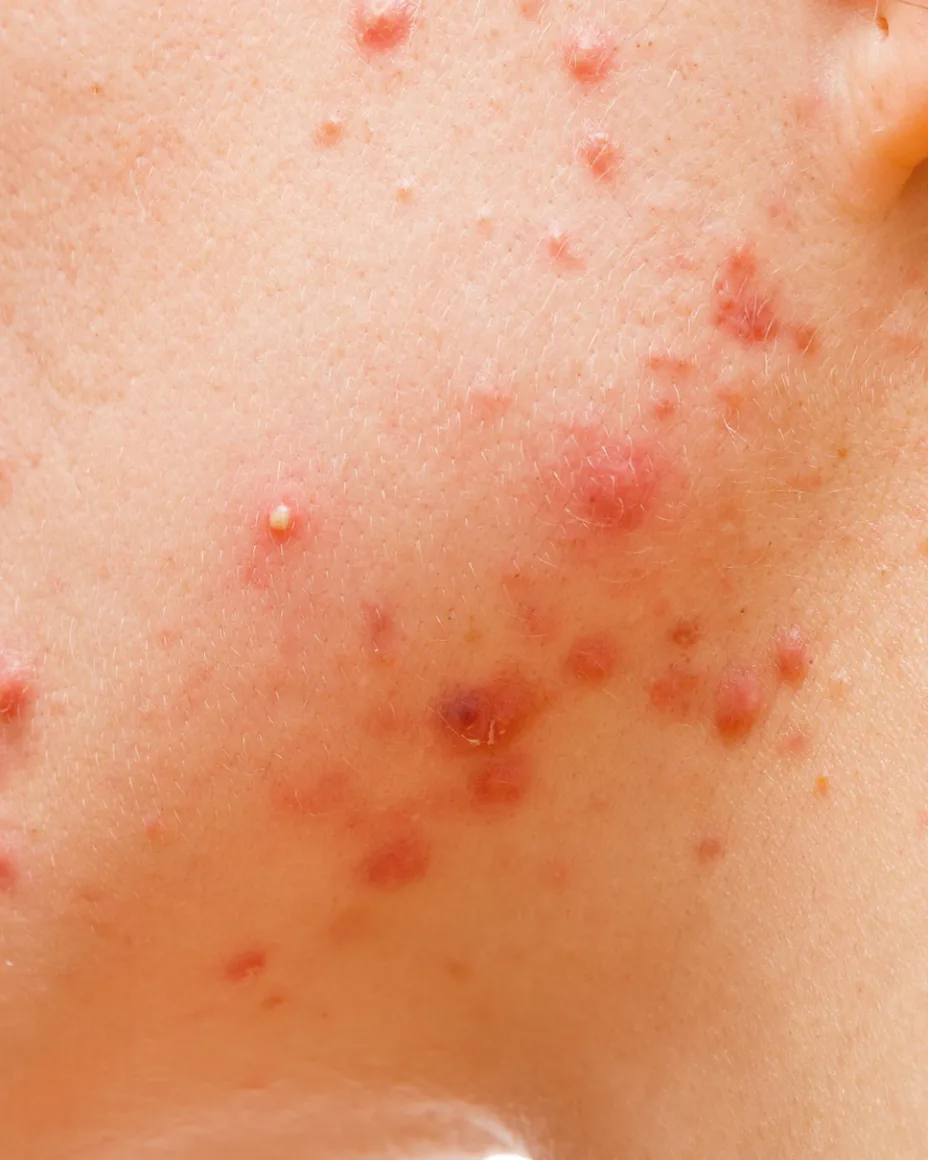
A few things make existing acne worse without having caused it: too little sleep, oily makeup and skin care, oily hair products, and stress. [1] So does picking. Never pick, pop, scratch or squeeze a breakout, which is the single most useful sentence on this page, because that is where a good many scars come from. [2]
Worth knowing it might not be acne
- Bumps and pustules across the cheeks and nose that acne products do not touch looks a lot like adult acne and is treated completely differently
- Breakouts that appeared suddenly in adulthood, in a pattern you have never had before
- Anything that started after a new medication, a new product or a new supplement
Acne is clogged pores driven by hormones and family history, not by how clean your skin is. [1] Which is why the answer is almost never washing more, and often washing less aggressively than you are now.
What causes it
Hormones, which is the engine
Hormones enlarge the oil glands and the glands make more oil, which clogs pores. [1] That is why acne arrives at puberty, why it tracks a monthly cycle for many women, and why it turns up again in adulthood around hormonal changes. It is also why treatment that works on the hormone side often succeeds when nothing applied to the surface has.
What you inherited
The risk is higher if one or both parents, or another close blood relative, had severe acne. [1] That is not a life sentence and it is useful information, because it tends to predict how early and how firmly to treat.
The things that make it worse without having started it
Not enough sleep, oily makeup and skin care, oily hair products such as pomade, and stress, which worsens existing acne rather than causing it. [1] Going through what you actually put on your skin and hair is a normal part of the first visit, and it is often the cheapest change available.
Preventing acne is how acne scars get prevented, which is why the recommendation is to treat acne from the first breakouts rather than waiting to see how bad it gets. [2]
Is it a scar, or a mark that was going to fade anyway?
This is the most useful question on the page and most people get it wrong in the expensive direction, buying scar treatment for something that was going to clear on its own. There is a test, it takes ten seconds, and you can run it at a bathroom mirror.
Stand square to a mirror under an overhead light, then tip your chin down and look up. Watch what happens to the spot as the light angle changes.
| A mark | A scar | |
|---|---|---|
| What you see | A flat spot of color where a breakout was [2] | An indent or a raised area, with the surface changed |
| Under angled light | Nothing changes. It stays a flat patch of color | It casts a small shadow, or catches the light on one edge |
| What it actually is | Post-inflammatory pigment, the skin’s color reaction to inflammation [2] | Lost or disordered tissue where the skin healed |
| What happens if you leave it | Discoloration generally fades over time [2] | Scars can soften and they rarely go away completely on their own [2] |
| What it needs | Time, daily sun protection, and a routine that does not irritate | An in-office treatment aimed at rebuilding the surface |
If it does not cast a shadow, it is color and time is on your side. Sun makes that color darker and slower to clear, so daily sun protection genuinely is the treatment for it, and sun makes those marks darker is the reason. If it does cast a shadow, that is where tiny needles that carry energy down to the scar and the strongest resurfacing we have earn their place.
One order matters underneath all of it: active breakouts get cleared before scars get treated. Resurfacing skin that is still breaking out treats a surface that is about to change again.
Where it shows up
| Area | What tends to happen there |
|---|---|
| Forehead and temples | Often where hair products play a part, and one of the easiest things to change. [1] |
| Cheeks | Where marks and scars both show most, because it is the flattest, most lit part of a face. |
| Jawline and chin | The classic adult and hormonal pattern, and often the most stubborn. |
| Nose and around it | Where it gets confused with rosacea, which is treated differently. |
| Chest and upper back | Frequently overlooked, harder to reach, and worth mentioning at the visit. |
| Shoulders | Where friction from straps and bags keeps it going. |
Best experience of my life! Helpful and take care of me on the spot!
The Coastal difference
Breakouts first, scars second, and we will tell you which you have
The order is clinical rather than commercial. Active acne gets cleared before scarring gets treated, because resurfacing skin that is still breaking out works on a surface that is about to change again. A practice that sells a scar course to somebody with active acne has sold the second step before the first.
The other half is telling a scar from a mark, which the shadow test above walks through and which we will do properly with you in person. A flat spot of color is not a scar and generally fades on its own. [2] That distinction saves people real money, and telling somebody their marks will clear with sun protection and patience is a normal outcome of this appointment. It is also where a dermatology practice differs from a treatment room: prescription treatment for the breakouts, in-office work for the scars, and a routine that works with your treatment underneath both.
Breakouts cleared first, scarring treated second. It is the sequence that makes the second step worth paying for, and it is the reason both halves live in one practice.
When to see a dermatologist
Book an appointment if:
- You have had breakouts for more than a few months and over-the-counter products have not settled them
- Your breakouts are deep, sore lumps rather than surface spots
- Acne is leaving marks or indents behind
- You have started breaking out in adulthood in a pattern you have not had before
- Acne products are not touching what you have, which sometimes means it is not acne looks a lot like adult acne
- You are picking at it, which is worth solving early rather than late
Sooner rather than later if:
- Anything is already leaving indents. Scars are prevented far more easily than they are treated [2]
- Acne is affecting how you feel about being seen, which is a real reason to treat it and not a frivolous one
The recommendation is to treat acne from the first breakouts rather than waiting to see how bad it gets, precisely because preventing the acne is how the scarring gets prevented. [2]
Living with it
Most of the result comes from what happens between appointments, and most of it is about doing less rather than more.
Worth doing
- Wash gently, twice a day, and stop there. Scrubbing an inflamed pore inflames it further
- Give a treatment its full run before judging it. Skin turnover takes weeks, not days
- Daily broad-spectrum sun protection, SPF 30 or higher, water resistant [3]
- Check your hair products, since what runs down a forehead in the shower ends up on it
- Bring everything you currently use to the visit. Going through it is part of the appointment
Worth knowing
- Never pick, pop, scratch or squeeze a breakout. [2] It is the fastest route from a spot to a scar
- Flat spots of color left behind are usually pigment rather than scarring, and they generally fade [2]
- Sun makes those marks darker and slower to clear, which is why sunscreen counts as treatment for them
- Where the same kind of discoloration appears across a whole face rather than at old breakout sites, that may be the same discoloration on the rest of a face instead
- Stress worsens existing acne rather than causing it, so a flare during a hard month is not a failure of your routine [1]
Treatments we offer
Clear the breakouts first, then treat what they left behind. Pick a treatment to see how it works.
What treatment costs
Treatment of active acne is medical care and is handled differently from the aesthetic treatments on this site. Our office will go through what applies to you when you book.
Treatment of acne scarring is a separate conversation with its own plan, and you will have that plan and its cost before anything is scheduled.
What it is
Clogged pores, where what clogs them decides the type of breakout [1]
What drives it
Hormones, and a higher risk if a parent or close relative had severe acne [1]
What does not cause it
Poor hygiene. Scrubbing harder makes it worse rather than better
Why treat early
Preventing acne is how acne scars get prevented [2]
Acne frequently asked questions
How long it takes to tell a mark from a scar at a bathroom mirror. Tip your chin and change the light angle: if it casts a shadow it is a scar, and if it stays flat it is color. The shadow test above walks through it.
Offered at
Ready to clear it? Request an appointment
Fill out the form below, book online in Santa Maria (opens online scheduler), or give us a call. Cosmetic and aesthetic appointments need no referral. For medical dermatology in San Luis Obispo, we are accepting new patients by referral from your primary care physician; send the referral across and then use the same form. In Santa Maria, medical appointments are available without a referral for PPO patients, and for HMO patients we are in-network with Santa Maria Physician's Choice.
Sources and medical review
1. American Academy of Dermatology Association. “Acne: Causes.” States that “acne develops when pores become clogged” and that “what type of acne you get depends on what clogs your pores.” Describes hormones during puberty enlarging the oil glands so they produce more oil that clogs pores, states that “you have a higher risk if one or both of your parents (or other close blood relative) had severe acne,” and names too little sleep, oily makeup and skin care products, oily hair products such as pomade, and stress, which worsens existing acne rather than causing it, among the things that make acne worse. https://www.aad.org/public/diseases/acne/causes/acne-causes · Medical Organization
2. American Academy of Dermatology Association. “Acne scars: Overview.” States that “if you see a flat spot of color on your skin when acne clears, this usually isn’t an acne scar. It’s likely post-inflammatory hyperpigmentation (PIH),” that “while acne scars can fade, they rarely go away completely on their own,” that discoloration generally disappears over time while the scar remains, describes depressed or sunken acne scars that give skin “a rough, uneven appearance,” states that “preventing acne can prevent acne scars. That’s why dermatologists recommend treating acne when you get your first breakouts,” and advises “never pick, pop, scratch, or squeeze breakouts.” https://www.aad.org/public/diseases/acne/derm-treat/scars · Medical Organization
3. American Academy of Dermatology Association. “How to select a sunscreen.” Broad spectrum, SPF 30 or higher, water resistant, reapplied every two hours outdoors and after swimming or sweating. https://www.aad.org/public/everyday-care/sun-protection/shade-clothing-sunscreen/how-to-select-sunscreen · Medical Organization
Content on this page is for educational purposes and is not a substitute for professional medical advice, diagnosis or treatment. Not every breakout is acne, and several conditions produce similar bumps. Response to treatment varies from person to person, and acne treatment usually takes weeks rather than days to show its effect. Resurfacing and microneedling carry risks including redness, swelling, infection, and lightening or darkening of the skin, which are discussed individually before anything is scheduled, and the risk of pigment change is higher on deeper skin tones. Prescription treatment is determined by your physician. Individual results may vary.