

A mole is a common, usually harmless growth of pigment cells in the skin, typically one color, round and unchanged from month to month. Moles are examined, monitored and where appropriate removed at Coastal Dermatology + Aesthetics in San Luis Obispo.
What a mole is, and what a normal one looks like
A mole is a cluster of pigment-producing cells that has grouped together instead of spreading evenly through the skin. Nearly every adult has a few, and most people with light skin acquire somewhere between ten and forty of them over a lifetime. [2] They can appear anywhere, including the scalp, between the fingers and toes, on the palms and soles, and under the nails. [1]
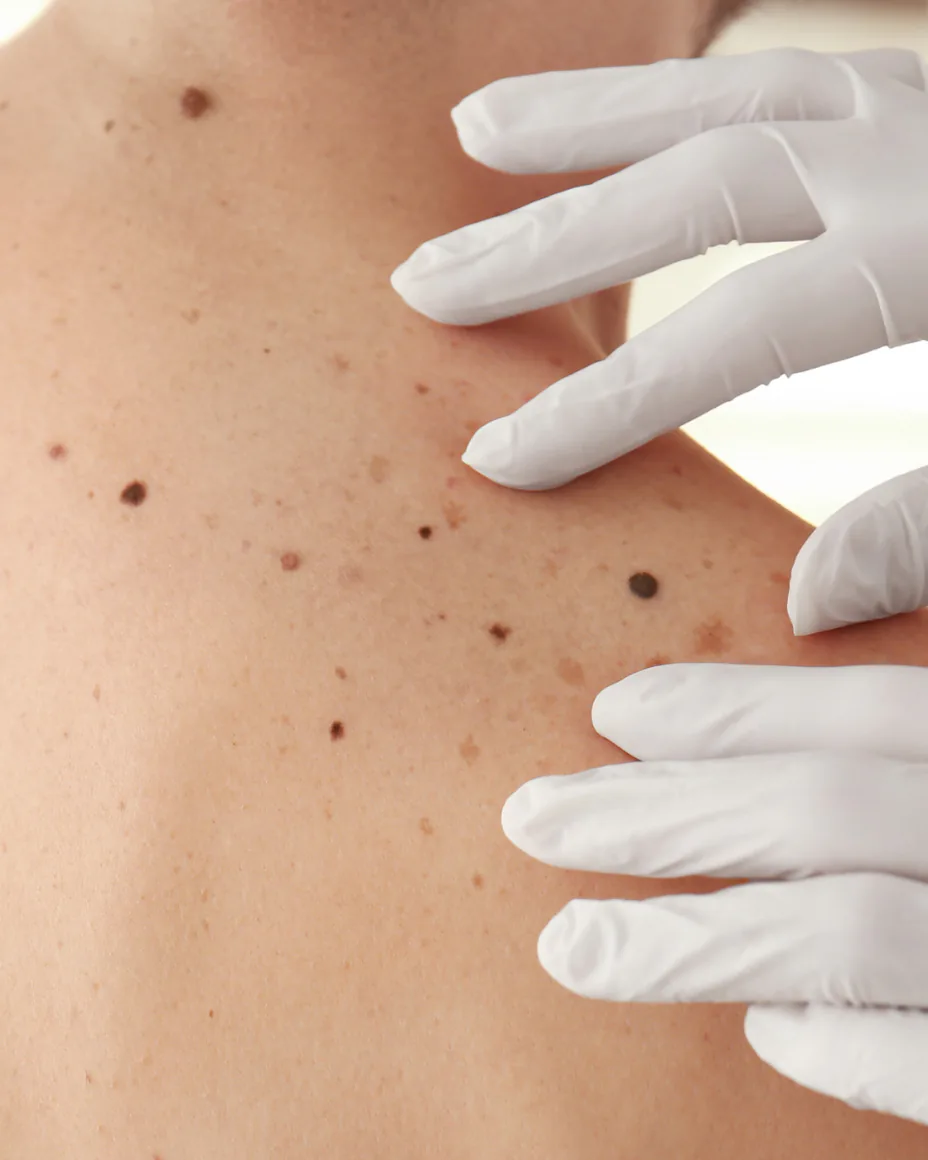
A common mole has a recognizable profile. One color, usually brown but sometimes tan, black, red, pink, blue, skin-toned or without color at all. Round. Flat or slightly raised. And, most usefully, unchanged from month to month. [1] A mole that has looked the same for twenty years is behaving exactly as it should.
Some moles simply look different from the rest. Atypical moles tend to be larger than a pencil eraser, irregular in shape, and made up of more than one color. [2] Having several of them is a reason to be checked on a schedule rather than a reason for alarm, and having them checked is the whole of what is being asked.
What is worth bringing in
- A mole that has changed in size, shape or color [1]
- A new spot that does not look like your other spots [1]
- A mole that itches, bleeds or will not heal [1]
- A mole with an irregular edge, more than one color, or larger than a pencil eraser [2]
- Anything on your skin you have started keeping an eye on
How long a mole check takes. The mole is examined through a lighted magnifier that picks up patterns of color and structure the naked eye cannot see. Most of the time the answer is reassuring and nothing further is needed.
Where they come from
Mostly, you were born to have them
Most moles are acquired: they appear after birth, generally through childhood and early adulthood, and how many you end up with is largely inherited. [2] About one person in a hundred is born with a congenital mole. [2] None of that is something you did, and none of it is something to correct.
Sun plays a part, and it plays a bigger part in what happens later
Ultraviolet exposure influences how many moles you develop and it is the main driver of melanoma risk. On the Central Coast, where people are outdoors year-round and the marine layer filters far less than it looks like it does, that exposure adds up quietly. The sun damage you can see and the rough, scaly patches that show up later come from the same account.
What raises the reason to be checked regularly
A high mole count, several atypical moles, fair skin that burns easily, a personal or family history of melanoma, and a suppressed immune system. [2] Each of these is a reason for a schedule rather than a reason to have moles taken off preemptively. Removing a harmless mole does not lower your risk. Being looked at on a regular basis is what does the work.
Moles most people with light skin acquire over a lifetime. [2] Having a lot of them is common. It is a reason to be on a schedule, not a reason to worry.
Two reasons to remove a mole, and two different appointments
Almost every question about mole removal gets easier once you separate these. They are different appointments, decided in a different order, and the method follows from which one you are in.
| The medical reason | The practical reason | |
|---|---|---|
| Why it is coming off | Something about it needs an answer: it has changed, it looks atypical, or it does not match your other spots | It has already been examined and found harmless, and it catches on a collar, a razor or a bra strap, or you would simply rather not have it |
| Who decides | Your dermatologist, after examining it | You do, once the medical question is settled |
| How it is done | Removed whole and sent to the laboratory, so the tissue can be read properly | Surgical excision or a surgical shave, chosen for the mole and the location [3] |
| Where the tissue goes | To the laboratory, every time | To the laboratory, every time [3] |
| What you get back | A diagnosis | A confirmation, because we do not skip that step |
| The order | This always comes first | This always comes second |
The one rule underneath all of it: every mole we remove is examined under a microscope, including the ones removed purely because you did not like them. [3] Nothing is judged harmless on appearance alone and then discarded. That is also why over-the-counter mole removal products and at-home methods are a bad trade. They can scar, they can leave cancer cells behind, and they delay a diagnosis. [3]
If something needs an answer before a decision can be made, a biopsy provides it, usually at the same visit.
Where they show up
| Area | Why it matters here |
|---|---|
| Back and shoulders | The most common site of melanoma in men, and the hardest area to watch yourself. |
| Legs | The most common site of melanoma in women, and easily overlooked. |
| Scalp | Moles form here too, and hair hides them completely. [1] |
| Face, neck and chest | The most examined skin on the body, and where a change gets noticed first. |
| Palms, soles and under the nails | Moles occur here, and these are places nobody thinks to check. [1] |
| Between fingers and toes | Moles form here too, and this is one of the most routinely missed places. [1] |
Dr. Kilcline is the best dermatologist! Best experience ever! Love her new beautiful facility & location.
The Coastal difference
The trained eye first, and the laboratory has the last word
Telling an unusual but harmless mole apart from an early melanoma is one of the things a board-certified dermatologist trains longest for, and it is done with a lighted magnifier rather than a glance. A dermatologist’s trained eye can often tell whether a spot is a mole. [3] Where looking is not enough, the tissue answers the question instead of a guess.
All of it happens in one place. The check, a biopsy if one is needed, the removal, and the follow-up visits afterward are at our San Luis Obispo office, with the same practice that has seen your skin before. That history is worth a great deal on this particular question, because “has this changed?” is much easier to answer when someone has looked at it before.
Every mole removed here is examined under a microscope, including the ones taken off purely for appearance. [3] Nothing is called harmless on the strength of how it looks and then thrown away.
When to see a dermatologist
Book an appointment if you notice:
- A mole changing in size, shape or color [1]
- A mole that itches, bleeds, or has a sore that will not heal [1]
- A new spot that looks different from all your other spots [1]
- A mole with an uneven edge, more than one color, or a diameter larger than a pencil eraser [1]
- A mole that has started to look different from its neighbors
Worth being on a schedule if:
- You have a lot of moles, or several that look atypical [2]
- You or a close relative has had a melanoma [2]
- You have fair skin that burns easily, or you used tanning beds at any point
- You have spent years outdoors on the Central Coast and have never had a full skin exam
A mole that has looked identical for years and does not itch or bleed is behaving normally. If you are not sure whether what you are seeing counts as a change, book the appointment. That is precisely what ten minutes is for.
What removal involves
Both methods are done in the office under local anesthetic, at the same visit where the decision is made where that is practical.
- Surgical excision. The mole is cut out and the skin closed with stitches where they are needed. [3]
- Surgical shave. The mole is removed at the surface with a blade, which suits raised moles. [3]
Either way, the tissue goes to the laboratory and is examined under a microscope. [3] You get the result, and you get it whether or not there is anything to report.
Afterward
- Keep the area clean and covered as instructed, and leave any dressing on for as long as you are told to
- Expect some tenderness for a few days, and follow the aftercare sheet rather than the internet
- Every removal leaves some mark. How noticeable it ends up depends on the size of the mole, where it sits, which method was used and how your skin heals, and your dermatologist will go through that with you before anything comes off
- A mole removed by shave can leave pigment at the base and regain color over time, which is one of the things weighed when the method is chosen
- Come back if the area gets more painful, redder or swollen after the first few days rather than less
Treatments we offer
Examination, biopsy, removal and follow-up, all in one practice. Pick a treatment to see how it works.
What treatment costs
Evaluation, biopsy and medically indicated removal are medical care rather than a cosmetic service, and are handled differently from the aesthetic treatments on this site. Our office will go through what applies to you when you book.
Where tissue is sent for examination, laboratory fees are billed separately by the laboratory that reads the sample, and we will tell you when a sample is being sent.
How common
Nearly every adult has a few, and most are common moles, which are harmless [2]
What a common one looks like
One color, round, flat or slightly raised, and unchanged from month to month [1]
How a mole check works
Examined with a lighted magnifier, about ten minutes, no preparation
What matters most
Change, and new spots that do not match your others [1]
Moles frequently asked questions
Melanomas that arise on skin where no mole was, rather than inside an existing one, pooled across 38 studies and more than 20,000 cases. [4] Which is why a skin exam looks at all of your skin, not only at your moles.
Offered at
Want a mole looked at? Request an appointment
Fill out the form below, book online in Santa Maria (opens online scheduler), or give us a call. Cosmetic and aesthetic appointments need no referral. For medical dermatology in San Luis Obispo, we are accepting new patients by referral from your primary care physician; send the referral across and then use the same form. In Santa Maria, medical appointments are available without a referral for PPO patients, and for HMO patients we are in-network with Santa Maria Physician's Choice.
Sources and medical review
1. American Academy of Dermatology Association. “Moles: Signs and symptoms.” States that a common mole is “one color,” which is “often brown, but a mole can be tan, black, red, pink, blue, skin-toned, or colorless,” that it is “round in shape,” “flat or slightly raised,” and “unchanged from month to month,” and that “moles can appear anywhere on the skin. They can develop on your scalp, between your fingers and toes, on the soles and palms, and even under your nails.” Also sets out the ABCDEs of melanoma: asymmetry, irregular border, more than one color, a diameter greater than about 6 millimeters, and a spot that is evolving. https://www.aad.org/public/diseases/a-z/moles-symptoms · Medical Organization
2. American Academy of Dermatology Association. “Moles: Who gets and types.” States that “nearly every adult has a few moles” and that “most adults have a type of mole called a common mole, which is harmless,” that most people with light skin acquire roughly 10 to 40 moles over a lifetime, that congenital moles are present at birth in about 1 in 100 people, that atypical moles “are often larger than an eraser on the end of a pencil,” irregular in shape and more than one color, and that having four or more atypical moles, or 50 or more common moles, is associated with an increased risk of melanoma. https://www.aad.org/public/diseases/a-z/moles-types · Medical Organization
3. American Academy of Dermatology Association. “Moles: Diagnosis and treatment.” States that “a dermatologist’s trained eye can often tell whether a spot is a mole,” that “most moles do not require treatment,” that a dermatologist removes a mole that is bothersome, unattractive or suspicious for cancer, describes surgical excision and surgical shave as the two removal procedures, states that removed tissue is examined under a microscope for cancer cells and that the patient is notified if any are found, and warns against at-home removal because cancer cells can be left behind and spread, because scarring can result, because equipment is not sterile, and because “products that remove moles can cause scarring and delay a skin cancer diagnosis.” https://www.aad.org/public/diseases/a-z/moles-treatment · Medical Organization
4. Pampena R, Kyrgidis A, Lallas A, Moscarella E, Argenziano G, Longo C. “A meta-analysis of nevus-associated melanoma: Prevalence and practical implications.” Journal of the American Academy of Dermatology. 2017;77(5):938-945. Pooled 38 observational studies covering 20,126 melanomas and found that “29.1% of melanomas likely arose from a preexisting nevus and 70.9% de novo.” PMID 28864306. https://pubmed.ncbi.nlm.nih.gov/28864306/ · Peer-Reviewed Study
Content on this page is for educational purposes and is not a substitute for professional medical advice, diagnosis or treatment. Appearance alone does not establish what a growth is; a diagnosis comes from tissue examined in a laboratory. Not every changing mole is a cancer, and not every skin cancer looks like a changing mole. Every removal leaves some mark, and healing varies by person, method and location. A mole removed by surgical shave can regain pigment over time. A skin examination is not a guarantee that every problem will be found, and anything that changes between appointments should be reported rather than waited on. Individual results may vary.