

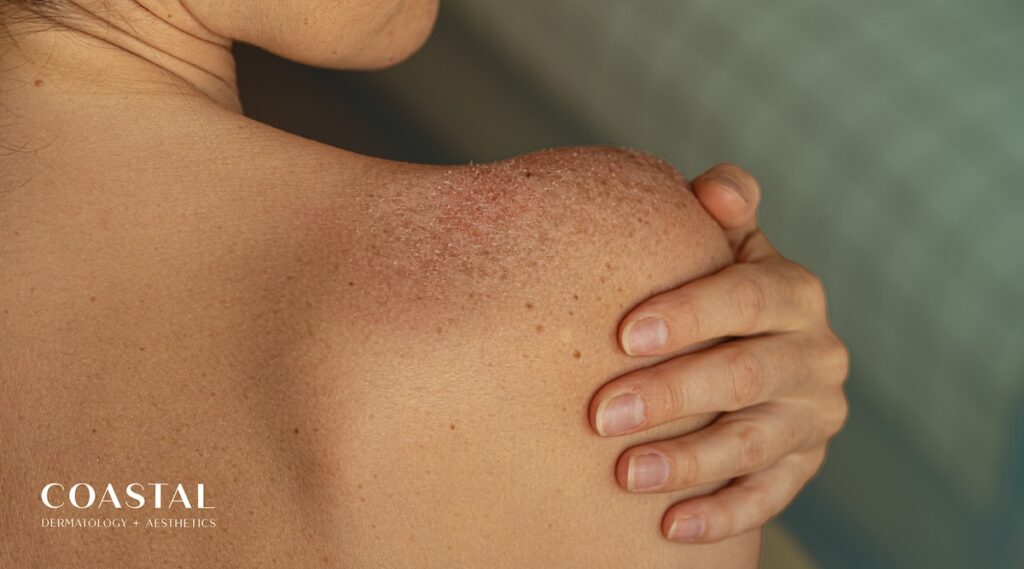
Most people think about sun protection in the moment, a day at the beach, a weekend hike, or a few hours in the garden. What is easy to forget is that your skin never forgets. Every unprotected minute in the sun, stretching back to childhood, is recorded in your skin at a cellular level. The effects do not always show up right away, but over time, that accumulated exposure becomes visible, and in some cases, it becomes a medical concern.
May is Skin Cancer Awareness Month, and for our team at Coastal Dermatology + Aesthetics, it is one of the most important reminders of the year. Not because sun damage is something to fear, but because understanding how it works gives you real power to address it.
How Sun Damage Accumulates Over a Lifetime
Ultraviolet radiation, both UVA and UVB, penetrates the skin and damages DNA within skin cells. UVB rays cause sunburn, while UVA rays penetrate deeper into the dermis, breaking down collagen and contributing to premature aging. Both types increase the risk of skin cancer.
The damage is cumulative, meaning it builds over decades. Research consistently shows that a significant portion of lifetime UV exposure happens before age 18, but that does not mean the window for prevention or correction has closed. In fact, the opposite is true: the earlier you understand what has accumulated, the more effectively you can protect and treat your skin going forward.
What Cumulative Sun Damage Looks Like
Sun damage does not always announce itself loudly. Early signs are often subtle and easy to attribute to “just getting older.” Knowing what to look for can make a meaningful difference.
Uneven pigmentation and age spots are among the most common signs. These flat brown or tan patches, sometimes called sunspots or liver spots, are areas where melanin has clustered in response to repeated UV exposure. They are most common on the face, chest, shoulders, and hands.
Changes in texture are another indicator. Skin that has been chronically sun-exposed often feels rougher, appears more leathery, and may show visible pore enlargement or a loss of the smooth surface that reflects healthy collagen levels.
Actinic keratosis, rough scaly patches that can feel like sandpaper, is where cosmetic concern crosses into medical concern. Actinic keratoses are considered precancerous and should be evaluated by a board-certified dermatologist. Left untreated, a small percentage can progress to squamous cell carcinoma. If you notice any persistent rough patches, particularly on sun-exposed areas, this is worth a conversation with our team.
A Health Concern and an Aesthetic One
One of the things that makes sun damage unique is that it sits squarely at the intersection of medical dermatology and aesthetics. The same UV exposure that elevates your risk for skin cancer is also responsible for up to 90 percent of the visible signs of aging, including fine lines, loss of elasticity, uneven tone, and persistent redness. Addressing it is not vanity. It is a comprehensive approach to skin health.
This is exactly the kind of care our practice is built around. Dr. Christine Kilcline and our clinical team are trained to evaluate your skin through both lenses, identifying what needs medical attention and what can be corrected with advanced aesthetic treatments.
What Can Be Done About Existing Sun Damage
The good news is that sun damage is highly treatable, and May is one of the best times of year to address it. The months before peak summer sun allow your skin to recover and rebuild between treatments, so you are protected heading into the season rather than working against it.
ThreeForMe Photorejuvenation is one of our most effective options for addressing the visible effects of chronic sun exposure. This light-based treatment targets brown spots, redness, and fine lines in a single session while stimulating the skin’s natural renewal process. For patients with significant pigmentation concerns or early signs of aging, it is a powerful place to start.
Chemical peels work by removing damaged surface layers and prompting new skin growth. They are particularly effective for improving uneven tone and texture, and they come in a range of depths to match your skin’s needs and your schedule.
HydraFacial offers a gentler, restorative approach that deeply cleanses, exfoliates, and infuses the skin with antioxidants and hydration. It is an excellent option for maintaining skin health between more intensive treatments and for patients who are new to addressing sun damage in-office.
The Daily Defense Layer: ZO Skin Health
In-office treatments correct what has already happened. What protects your skin going forward is what you do every single day.
Our practice carries a curated line of ZO Skin Health products, a medical-grade collection formulated to address the cellular drivers of sun damage, not just the surface symptoms. Dr. Kilcline holds ZO Circle Club Blue Diamond status for 2026, the highest level achievable within the ZO program. That level of expertise means our product recommendations are always tailored, never generic.
A well-designed daily regimen for sun-damaged or sun-exposed skin typically includes a broad-spectrum SPF applied every morning as a non-negotiable foundation, antioxidant support to neutralize free radical damage from UV exposure throughout the day, and a retinol or retinoid-based product to accelerate cellular turnover and help correct existing pigmentation and texture concerns over time. These are not complicated additions. They are the difference between skin that continues to age and skin that actively repairs.
May Is the Right Time to Start
You do not have to look at sun damage as something that has already been done to your skin. With the right assessment and a thoughtful plan, much of it can be corrected, and the rest can be stopped from progressing.
If you have noticed changes in your skin and are not sure what they mean, or if you simply want to understand where your skin stands and what your options are, a skincare consultation with our team is the right first step. We see patients at our San Luis Obispo and Santa Maria locations and are happy to walk you through what we are seeing, what it means, and how we can help.
To schedule a consultation, call us at (805) 544-5567 or click HERE to book online. Our ZO Skin Health collection is available in-office. Stop by or call to learn which products are right for your skin.