---
title: "Warts"
---
A wart is a common, non-cancerous skin growth caused by the human papillomavirus. [1] There are more than 200 different types of HPV, and different types produce different warts in different places. [1] Once you understand that a wart is an infection rather than a lump of thickened skin, everything else about it makes sense.
It explains the spread: **warts are contagious, and you can pass the virus to other people and to other parts of your own body.** [1] When it spreads, new warts form. [1] It explains the timeline: it usually takes a few months for a wart to grow large enough to see, so the one you noticed this week arrived a while ago. [1] And it explains why treatment aims at the whole thing rather than the surface.
**The black dots are blood vessels**, not seeds and not dirt. [2] That is worth knowing because it is the single most common misconception about warts, and because picking at them to get the "seeds" out is how they spread.
**What they look like** [2]
- Round, flat, rough, smooth, or shaped like a cauliflower
- The same color as your skin, or brown, gray, black, pale yellow, white or pink
- A common wart is often a round or oval, rough bump, usually on hands, knuckles or around a nail
- A plantar wart on the sole is a rough, thickened growth that often contains small black dots
- A flat wart is smaller and smoother, with a flat surface, often on the face or on skin you shave
- A filiform wart looks like it has threads or tentacles sticking out of it
Most warts are harmless and will go away on their own if you have a healthy immune system, and it can take a few months to years for that to happen. [1] So "do nothing" is a legitimate option, and it is not the right option for every wart. Here is how the three routes actually divide.
Your situationThe reasonable routeWhyOne or two warts, on a hand, not painful, not spreading, and you are not botheredWaitMost clear on their own in a healthy immune system, though it can take months to years [1]A wart you would rather be rid of, in an ordinary spot, and you have not tried anything yetHome treatment firstSoften in warm water, apply salicylic acid, cover with duct tape or a bandage [4]Home treatment has not worked, or the wart is spreadingCome inStubborn warts have in-office options that home treatment does not [4]A wart on your face or genital areaCome in [4]Site changes what is safe and appropriate to useA wart that is changing, painful, itching, burning or bleedingCome in [4]Those are the features worth having examined rather than treatedMany warts, or new ones keep appearingCome in [4]A pattern is worth understanding rather than treating one at a timeYou have a weakened immune system or diabetesCome in [4]Both change the calculation on anything done at homeAny doubt about whether it is a wart at allCome in [4]This is the important one, and The Coastal difference below is about it
Two things the table cannot decide for you. The first is patience: "a few months to years" is a real range, and choosing to wait is choosing to live with it for an unknown stretch. [1] The second is spread. A wart you are waiting out is contagious the entire time, to you and to other people, until you no longer see or feel it. [1]
AreaWhat tends to appear there [2]Hands, knuckles, around a nailThe most common site, and where common warts turn upSoles of the feetPlantar warts, rough and thickened, often with black dots, and often uncomfortable to stand onFaceFlat warts, smaller and smoother, and a site where treatment choice matters moreSkin you shaveWhere microtears let the virus in and where warts spread in a line [3]Elbows and kneesCommon in children, and easily passed alongAnywhere with a break in the skinWhich is why a small cut is worth covering rather than ignoring
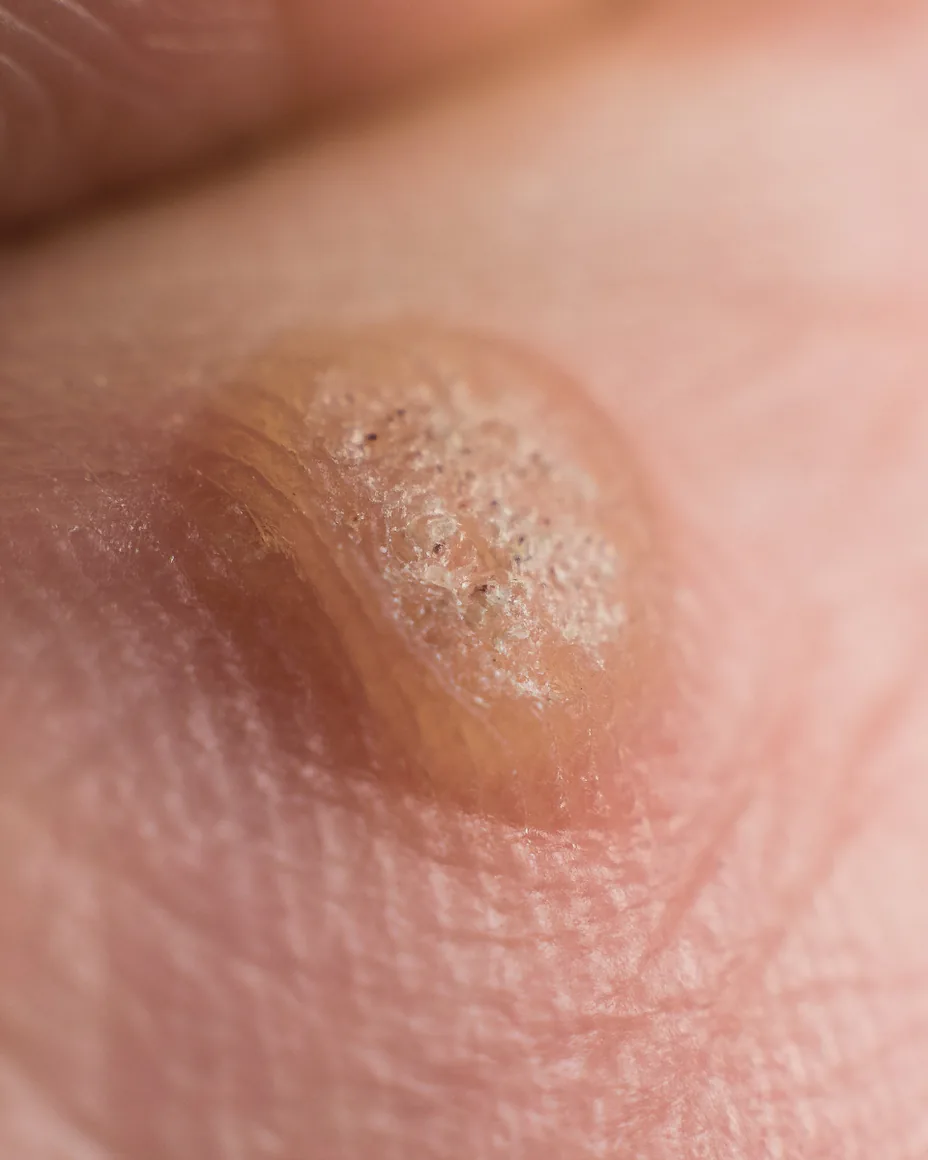
Plenty of things look like warts. [Skin tags](/conditions/skin-tags/), [moles](/conditions/moles/) and a handful of other growths get treated at home as warts for months, and a small number of things that look like a stubborn wart are [a growth that needs an answer](/conditions/skin-cancer/) instead. A wart that is growing rapidly, looks like an open sore, or fails to clear with treatment is exactly the situation where a sample gets sent to a laboratory rather than another round of acid applied to it. [4]
That is the actual argument for coming in, and it costs one appointment. After that the range is wide: freezing, a medication painted on in the office that raises a blister under the wart, burning it off, cutting it out, immunotherapy that gets your own immune system to fight the virus, and [a laser aimed at one spot](/treatments/smartskin-laser-skin-resurfacing/) for warts that have not cleared with anything else. [4] Which one suits depends on the wart, the site and what has already been tried, and that is a judgment rather than a menu.
**Book an appointment if:** [4]
- You have warts on your face or genital area
- A wart is changing, hurts, itches, burns or bleeds
- You have many warts
- You have any doubt about whether it is a wart
- Home treatment has not cleared it
- You have a weakened immune system, or diabetes
**Also worth booking if:**
- Warts keep appearing in new places, which usually means the virus is being spread by something in your routine
- A wart on the sole is painful to walk on
- You shave over a wart, which spreads it reliably
A dermatologist can usually diagnose warts by looking at them. [4] Where a wart is growing rapidly, looks like an open sore, or has not cleared with treatment, a small sample goes to a laboratory. [4]
Warts stay contagious until you no longer see or feel them. [1] Everything below is aimed at that window.
**Worth doing**
- Cover a wart, particularly one on a hand or a foot that touches shared surfaces
- Do not shave over a wart. Shave around it, or leave that area until it has cleared
- Wear something on your feet in pool areas, communal showers, gyms and locker rooms [3]
- Keep your own towel, and do not share nail clippers or files
- Wash your hands after touching one, including your own
**Worth knowing**
- The black dots are blood vessels. Digging at them does not remove anything and does spread the virus [2]
- Most warts clear on their own in a healthy immune system, and it can take months to years [1]
- It usually takes a few months for a wart to grow large enough to see, so a new one was not caught this week [1]
- Home salicylic acid works better on skin softened in warm water first, and covered afterward [4]
- Freezing in the office usually heals within four to seven days and may be repeated every two to four weeks [4]
Identification first, then the treatment that suits the wart, the site and how stubborn it has proven. Pick a treatment to see how it works.
Diagnosis and treatment of warts are medical care rather than a cosmetic service, and are handled differently from the aesthetic treatments on this site. Our office will go through what applies to you when you book.
Where a sample is sent for examination, laboratory fees are billed separately by the laboratory that reads it, and we will tell you when a sample is being sent.
**Q: Are warts contagious?**
Yes. Warts are contagious, and they stay contagious until you no longer see or feel them. [1] You can spread the virus to other people and to other parts of your own body, and when it spreads, new warts form. [1] That is the strongest argument for treating one rather than waiting it out.
**Q: What are the little black dots?**
Blood vessels. [2] Not seeds, not dirt, and not something to be extracted. The "seeds" idea is the most persistent myth about warts and it leads directly to people digging at them, which is one of the more reliable ways to end up with several.
**Q: Will it go away on its own?**
Probably, eventually. Most warts are harmless and will go away on their own if you have a healthy immune system, and it can take a few months to years. [1] Whether that is acceptable depends on where it is, whether it hurts, and whether you are comfortable being contagious for that long.
**Q: Does freezing hurt, and how many times?**
Freezing is done in the office and the treated area usually heals within four to seven days. [4] It may be repeated every two to four weeks. [4] How many rounds a particular wart needs is not something anyone can promise in advance, and you will get a realistic picture after it has been looked at.
**Q: Why do I keep getting new ones?**
Usually because something in your routine keeps letting the virus in or moving it around: shaving over one, going barefoot in a shared wet space, or picking at one. [3] A pattern of new warts is worth a visit rather than treating each one as it appears.
**Q: Can a wart be something else?**
Sometimes, and that is the reason to have one looked at rather than assumed. A wart that is growing rapidly, looks like an open sore, or has not cleared with treatment gets a small sample sent to a laboratory. [4] Skin tags and moles also get treated at home as warts more often than you would expect.
**Q: Do I need a referral?**
Yes. This is medical dermatology, and the practice is currently accepting new medical patients by referral from your primary care physician. Once you have that, call the office and we will get you in.
1. American Academy of Dermatology Association. "Warts: FAQs." States that "a wart is a common, non-cancerous skin growth caused by the human papillomavirus (HPV)," that "there are more than 200 different types of HPV," that "if you have a wart, you can spread the virus that causes it to other people and to other parts of your body," that "when the virus spreads, new warts can form," that "yes. Warts are contagious," that "warts are contagious until you no longer see or feel them," that "it usually takes a few months for a wart to grow large enough to see," and that "most warts are harmless and will go away on their own if you have a healthy immune system. However, it can take a few months to years for a wart to disappear." [https://www.aad.org/public/diseases/a-z/warts-overview](https://www.aad.org/public/diseases/a-z/warts-overview) · Medical Organization
2. American Academy of Dermatology Association. "Warts: Signs and symptoms." States that "a wart can be round, flat, rough, smooth, or cauliflower shaped," that "a wart may be the same color as your skin, or it may be brown, gray, black, pale yellow, white, or pink," that of the black dots inside a wart "the dots are blood vessels," that "a common wart often looks like a round or oval, rough bump," that plantar warts "often look like rough, thickened growths that often contain small, black dots," that flat warts "are smaller than common warts and have a smooth, flat surface," that filiform warts "look like they have tentacles or threads sticking out," and that most warts appear on the hands, especially the knuckles or around a nail, the feet usually on the bottom, elbows, knees, skin that you shave, the face, or the genitals. [https://www.aad.org/public/diseases/a-z/warts-symptoms](https://www.aad.org/public/diseases/a-z/warts-symptoms) · Medical Organization
3. American Academy of Dermatology Association. "Warts: Causes." States that "shaving creates microtears in the skin. HPV can infect you through a microtear," that warts are common in children and teens because they "frequently touch each other's skin, have a cut or scrape, or share unwashed clothing or towels," and names as risk factors having skin that is softened by water, walking barefoot in a pool area, communal shower, gym or locker room, having a weakened immune system, being pregnant, having atopic dermatitis with asthma or hay fever, and handling raw meat or poultry. [https://www.aad.org/public/diseases/a-z/warts-causes](https://www.aad.org/public/diseases/a-z/warts-causes) · Medical Organization
4. American Academy of Dermatology Association. "Warts: Diagnosis and treatment." States that "your dermatologist can usually diagnose warts by looking at them," and that a biopsy may be taken if "a wart is growing rapidly, looks like an open sore, or fails to clear with treatment." Names salicylic acid, cryosurgery ("the treated area usually heals within 4 to 7 days" and treatment "may be repeated every 2 to 4 weeks"), occlusion, cantharidin ("also known as beetle juice, cantharidin causes a blister to form around and under the wart"), electrosurgery and curettage, excision, laser ("a laser can effectively treat stubborn warts and may clear them quickly"), bleomycin, immunotherapy ("this treatment stimulates your immune system, so it can more effectively fight the wart-causing virus"), 5-fluorouracil and trichloroacetic acid. Lists reasons to see a dermatologist including "warts on your face or genital area," "a wart that is changing, hurts, itches, burns, or bleeds," "many warts," "doubts about whether you have a wart(s)," failed at-home treatment, a weakened immune system, and diabetes. Describes home care as softening in warm water, applying salicylic acid, and covering the treated wart with duct tape or a bandage. [https://www.aad.org/public/diseases/a-z/warts-treatment](https://www.aad.org/public/diseases/a-z/warts-treatment) · Medical Organization
Content on this page is for educational purposes and is not a substitute for professional medical advice, diagnosis or treatment. Not every rough growth is a wart, and a growth that is changing, growing rapidly, bleeding or failing to clear should be examined rather than treated at home. Warts are caused by a virus and can recur or spread; the number of treatments needed varies from person to person and from wart to wart. In-office treatments carry risks including discomfort, blistering, temporary changes in skin color and, less commonly, scarring, which are discussed before treatment. Individual results may vary.
```ld+json
{
"@context": "https://schema.org",
"@graph": [
{
"@context": "https://schema.org",
"@type": "MedicalCondition",
"@id": "https://coastaldermaesthetics.com/conditions/warts/#concern",
"name": "Warts",
"url": "https://coastaldermaesthetics.com/conditions/warts/",
"description": "A wart is not a lump of hard skin. It is a virus living in your skin, which explains everything people find frustrating about warts: why they spread, why they come back, and why treatments that only sand down the surface never finish the job.",
"image": {
"@type": "ImageObject",
"contentUrl": "https://coastaldermaesthetics.com/wp-content/uploads/2026/07/warts-2x-1024x512.jpg",
"width": 1024,
"height": 512,
"caption": "large wart on finger"
},
"possibleTreatment": [
{
"@type": "MedicalTherapy",
"name": "Skin Care Consultations",
"url": "https://coastaldermaesthetics.com/treatments/skin-care-consultations/"
},
{
"@type": "MedicalTherapy",
"name": "Smartskin®+ Laser Skin Resurfacing",
"url": "https://coastaldermaesthetics.com/treatments/smartskin-laser-skin-resurfacing/"
}
]
},
{
"@context": "https://schema.org",
"@type": "MedicalWebPage",
"@id": "https://coastaldermaesthetics.com/conditions/warts/#webpage",
"name": "Warts",
"url": "https://coastaldermaesthetics.com/conditions/warts/",
"mainEntity": {
"@id": "https://coastaldermaesthetics.com/conditions/warts/#concern"
},
"lastReviewed": "2026-08-01",
"reviewedBy": {
"@type": "Person",
"@id": "https://coastaldermaesthetics.com/providers/dr-christine-kilcline/#provider",
"name": "Dr. Christine Kilcline",
"url": "https://coastaldermaesthetics.com/providers/dr-christine-kilcline/"
},
"about": [
{
"@type": "MedicalSpecialty",
"name": "Dermatology",
"sameAs": "https://www.wikidata.org/wiki/Q171171"
},
{
"@type": "MedicalCondition",
"name": "Wart",
"sameAs": "https://www.wikidata.org/wiki/Q101971"
}
],
"speakable": {
"@type": "SpeakableSpecification",
"cssSelector": [
".geo-summary"
]
}
},
{
"@context": "https://schema.org",
"@type": "BreadcrumbList",
"itemListElement": [
{
"@type": "ListItem",
"position": 1,
"name": "Home",
"item": {
"@id": "https://coastaldermaesthetics.com/",
"@type": "WebSite",
"name": "Home"
}
},
{
"@type": "ListItem",
"position": 2,
"name": "Concerns",
"item": {
"@id": "https://coastaldermaesthetics.com/conditions/",
"@type": "CollectionPage",
"name": "Concerns"
}
},
{
"@type": "ListItem",
"position": 3,
"name": "Warts",
"item": "https://coastaldermaesthetics.com/conditions/warts/"
}
]
},
{
"@context": "https://schema.org",
"@type": "Question",
"name": "Warts",
"acceptedAnswer": {
"@type": "Answer",
"text": "A wart is a common, non-cancerous skin growth caused by the human papillomavirus. Warts are contagious, they can spread to other people and to other parts of your own body, and many clear eventually on their own. Stubborn ones are treated at Coastal Dermatology + Aesthetics in San Luis Obispo."
},
"isPartOf": {
"@id": "https://coastaldermaesthetics.com/conditions/warts/#webpage"
},
"url": "https://coastaldermaesthetics.com/conditions/warts/"
},
{
"@context": "https://schema.org",
"@type": "Review",
"reviewBody": "The staff is terrific, front to back. Thank you, Dr. Kilcline, for the great work today.",
"itemReviewed": {
"@type": "Organization",
"@id": "https://coastaldermaesthetics.com/#organization",
"name": "Coastal Dermatology + Aesthetics"
},
"author": {
"@type": "Person",
"name": "Steve P."
},
"reviewRating": {
"@type": "Rating",
"ratingValue": 5,
"bestRating": 5
}
},
{
"@context": "https://schema.org",
"@type": "FAQPage",
"mainEntity": [
{
"@type": "Question",
"name": "Are warts contagious?",
"acceptedAnswer": {
"@type": "Answer",
"text": "Yes. Warts are contagious, and they stay contagious until you no longer see or feel them. [1] You can spread the virus to other people and to other parts of your own body, and when it spreads, new warts form. [1] That is the strongest argument for treating one rather than waiting it out.
"
}
},
{
"@type": "Question",
"name": "What are the little black dots?",
"acceptedAnswer": {
"@type": "Answer",
"text": "Blood vessels. [2] Not seeds, not dirt, and not something to be extracted. The \"seeds\" idea is the most persistent myth about warts and it leads directly to people digging at them, which is one of the more reliable ways to end up with several.
"
}
},
{
"@type": "Question",
"name": "Will it go away on its own?",
"acceptedAnswer": {
"@type": "Answer",
"text": "Probably, eventually. Most warts are harmless and will go away on their own if you have a healthy immune system, and it can take a few months to years. [1] Whether that is acceptable depends on where it is, whether it hurts, and whether you are comfortable being contagious for that long.
"
}
},
{
"@type": "Question",
"name": "Does freezing hurt, and how many times?",
"acceptedAnswer": {
"@type": "Answer",
"text": "Freezing is done in the office and the treated area usually heals within four to seven days. [4] It may be repeated every two to four weeks. [4] How many rounds a particular wart needs is not something anyone can promise in advance, and you will get a realistic picture after it has been looked at.
"
}
},
{
"@type": "Question",
"name": "Why do I keep getting new ones?",
"acceptedAnswer": {
"@type": "Answer",
"text": "Usually because something in your routine keeps letting the virus in or moving it around: shaving over one, going barefoot in a shared wet space, or picking at one. [3] A pattern of new warts is worth a visit rather than treating each one as it appears.
"
}
},
{
"@type": "Question",
"name": "Can a wart be something else?",
"acceptedAnswer": {
"@type": "Answer",
"text": "Sometimes, and that is the reason to have one looked at rather than assumed. A wart that is growing rapidly, looks like an open sore, or has not cleared with treatment gets a small sample sent to a laboratory. [4] Skin tags and moles also get treated at home as warts more often than you would expect.
"
}
},
{
"@type": "Question",
"name": "Do I need a referral?",
"acceptedAnswer": {
"@type": "Answer",
"text": "Yes. This is medical dermatology, and the practice is currently accepting new medical patients by referral from your primary care physician. Once you have that, call the office and we will get you in.
"
}
}
]
}
]
}
```