---
title: "Vitiligo"
---
Vitiligo is a condition that causes skin to lose color. Areas of skin may look lighter than your natural skin tone, white, or even pink. [1] It is autoimmune: **the immune system mistakes the cells that give skin, hair and eyes their color as foreign, and attacks and destroys them.** [3] Those cells are called melanocytes, and where they are gone, color is gone.
The first patches usually appear on the face, arms, hands and feet, and it can develop anywhere on the skin. [2] When it is actively spreading, patches can look pink, or show three tones at once, with a band of tan between your natural color and the white patch. [2] Hair growing in an affected area can turn white, and color can be lost inside and around the mouth and nose. [2]
**Two things it is not.** It is not contagious: you cannot catch vitiligo from anyone or give it to anyone. [1] And it does not increase your risk of skin cancer. [1] What it does do is leave skin without its natural protection from light, which is why sun protection is treatment here rather than general advice.
**Worth knowing at diagnosis**
- About half the people who develop vitiligo get it before they turn 20 [3]
- People of all races and skin tones develop it [3]
- It is most visible when someone has a darker skin tone or a tan [1]
- It can run in families, and having a close relative with it does not mean you will get it. A number of genes are involved [3]
- It travels with other autoimmune conditions, including alopecia areata and thyroid disease [3]
Vitiligo is one of the conditions where people are told either far too much or nothing at all. Here is the actual shape of it, with the figures that exist rather than the ones that would be convenient.
The questionThe honest answerCan it be cured?No. Treatment cannot cure vitiligo, and it may restore lost skin color [5]Does treatment work?For a substantial share of people. In clinical trials of one prescription cream, about 30 percent of patients saw 75 percent of their skin color restored by week 24 [5]How fast?Slowly. That 24-week figure is the point at which results were measured, not the point at which they start [5]Will it hold?Often, with maintenance. Within a year of stopping treatment, an estimated 40 percent of patients see some color loss [5]What if I do nothing?Vitiligo is not harmful to your health and does not raise skin cancer risk. [1] Doing nothing is a legitimate choice, and skin without pigment still needs sun protection
**Read those two percentages together rather than separately.** Thirty percent reaching three-quarters restoration in under six months is a real result for a condition that had very little a decade ago. Forty percent seeing some loss within a year of stopping is the reason maintenance is part of the plan rather than a sign anything failed.
Everything on that list assumes the one thing that is not optional: protection from light. Skin that has lost its color sunburns easily, [skin that burns easily](/conditions/sun-damage/) is the practical consequence, and severe sunburn is itself a trigger for more vitiligo. [3] [4]
AreaWhat tends to happen thereFaceOne of the first sites, and where it is most visible. [2]HandsThe other common first site, and the hardest area to keep protected. [2]ArmsFrequently affected, and where sun exposure compounds it. [2]FeetCommon, and often noticed late. [2]Around the mouth and noseIncluding inside the mouth and inside the nose. [2]Hair in affected areasCan turn white where pigment cells are gone. [2]
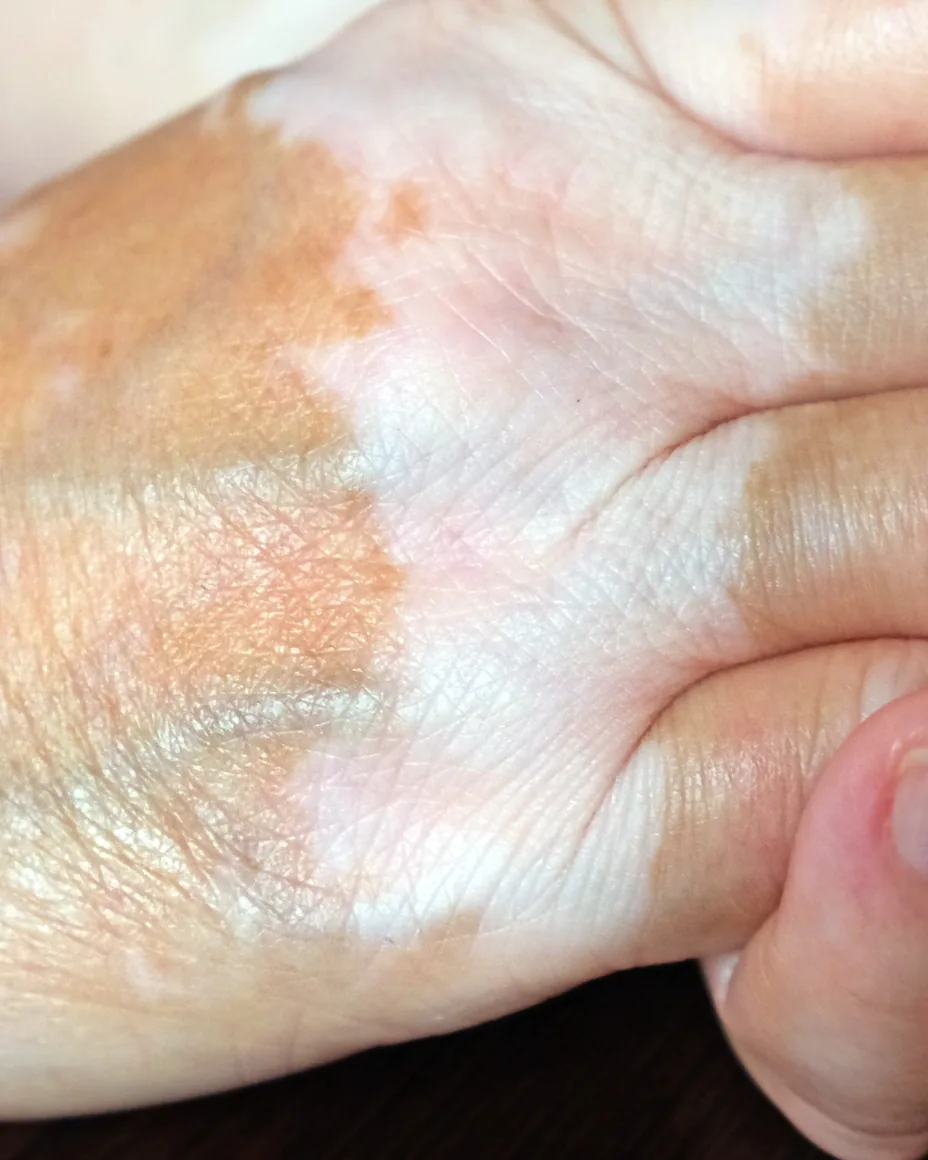
The range for vitiligo has widened. Alongside topical corticosteroids used for limited periods, there are non-steroid creams that can be used for longer, a prescription cream approved specifically for vitiligo, light-based treatment, and for stable disease, procedures that move pigment cells. [5] There is also the option people are least often offered: camouflage makeup or self-tanner, used deliberately, which restores appearance immediately and commits to nothing. [4] [5]
Which combination suits you depends on where it is, how much there is, whether it is spreading, and, honestly, on what you want out of it. Some people want repigmentation and will run a course for months. Some want their hands covered for a wedding. Some want to be told it is harmless and go home. **All three are legitimate outcomes of this appointment**, and a board-certified dermatologist who says so is more useful than one who assumes.
**Book an appointment if:**
- Areas of your skin have lost color, or look lighter than your natural tone
- Patches are appearing in new places, or an existing patch is spreading
- Hair in an affected area has turned white [2]
- You have lost color around the mouth, the nose or the lips [2]
- You want to know what it is before deciding whether to treat it
**Worth raising at the same visit:**
- Any personal or family history of thyroid disease or alopecia areata [3]
- Any change in hearing or eyesight, both of which are named alongside vitiligo [3]
- Any plan to get a tattoo, which is worth discussing first [4]
Diagnosis is by reviewing your medical history and examining your skin, sometimes with a specialized light. [5] Nothing about it requires preparation.
Two things run in parallel here: protecting skin that has lost its defenses, and deciding for yourself how much you want to change how it looks.
**Worth doing**
- Protect your skin from the sun. Skin that has lost its natural color sunburns easily. Broad spectrum, water resistant, SPF 30 or higher [4]
- Long sleeves, long trousers, a wide-brimmed hat and sunglasses with UV protection [4]
- Avoid indoor tanning entirely [4]
- Avoid cuts, scrapes and burns where you reasonably can, since injury can trigger new spots [4]
- Use makeup, self-tanner or skin dye if you would like to add color. Waterproof options exist and they work [4]
**Worth knowing**
- New spots from a skin injury tend to appear about 10 to 14 days afterward, which is why tattoos over affected skin are worth discussing first [4]
- Vitiligo is not contagious and does not raise your risk of skin cancer [1]
- Hearing and eyesight problems are named alongside vitiligo, so mention any change [3]
- Looking after your mental health is named as part of self-care, and it belongs there [4]
- The opposite problem, where skin makes too much pigment, is a different condition entirely and gets confused with this one surprisingly often
Diagnosis, prescription treatment, light-based treatment, and the sun protection that everything else depends on. Pick a treatment to see how it works.
Diagnosis and treatment of vitiligo are medical care rather than a cosmetic service, and are handled differently from the aesthetic treatments on this site. Our office will go through what applies to you when you book.
Where a plan runs over months, you will have the shape of it and its cost before anything is started rather than partway through.
**Q: Is vitiligo contagious?**
No. You cannot catch vitiligo from someone or give it to anyone. [1] It is an autoimmune condition happening inside your own body.
**Q: Is it harmful to my health?**
No. Vitiligo can change your appearance and it is not harmful to your health. [1] It also does not increase your risk of developing skin cancer. [1] What it does do is remove your skin's natural protection from light in the affected areas, which is why sun protection matters more here than almost anywhere.
**Q: Can it be cured?**
No. Treatment cannot cure vitiligo, and it may restore lost skin color. [5] The section above sets out what that means in practice, including the figures, because a realistic picture is more useful than either extreme.
**Q: How well does treatment work, and how long does it take?**
In clinical trials of one prescription cream, about 30 percent of patients saw 75 percent of their skin color restored by week 24. [5] Within a year of stopping treatment, an estimated 40 percent of patients see some color loss. [5] Both numbers matter: the first is why treatment is worth starting, the second is why maintenance is part of the plan.
**Q: Will it spread?**
It can, and it does not always. Severe sunburn, skin injury and certain chemicals are named triggers, and skin injury in particular can produce new spots about 10 to 14 days later. [3] [4] Protecting your skin and avoiding cuts and burns where you can is the practical version of managing that.
**Q: Do I have to treat it?**
No, and that is a real answer rather than a polite one. Vitiligo is not harmful to your health. [1] Some people treat it, some use camouflage, and some do neither. What everybody should do regardless is protect skin that has lost its pigment from the sun.
**Q: Do I need a referral?**
Yes. This is medical dermatology, and the practice is currently accepting new medical patients by referral from your primary care physician. Once you have that, call the office and we will get you in.
1. American Academy of Dermatology Association. "Vitiligo: FAQs." States that "vitiligo is a condition that causes skin to lose color. Areas of skin may look lighter than your natural skin tone, white, or even pink," that "vitiligo is most visible when someone has a darker skin tone or a tan," that "no. You cannot catch vitiligo from someone or give it to anyone," that vitiligo "can change your appearance, it isn't harmful to your health," and that in answer to whether vitiligo increases the risk of developing skin cancer, "no." [https://www.aad.org/public/diseases/a-z/vitiligo-overview](https://www.aad.org/public/diseases/a-z/vitiligo-overview) · Medical Organization
2. American Academy of Dermatology Association. "Vitiligo: Signs and symptoms." Describes patches that when active can appear "pink or tricolor (causing a zone of tan skin between a person's natural skin color and the white vitiligo)," names the face, arms, hands and feet as common first sites and states it "can develop anywhere on a person's skin," that affected skin "sunburn[s] easily," that hair in affected areas can "turn white," and describes "loss of color in the mouth, on the lips, around the mouth, around the nose, or inside the nose." [https://www.aad.org/public/diseases/a-z/vitiligo-symptoms](https://www.aad.org/public/diseases/a-z/vitiligo-symptoms) · Medical Organization
3. American Academy of Dermatology Association. "Vitiligo: Causes." States that "vitiligo is an autoimmune disease. This type of disease develops when your immune system mistakes part of your body as foreign," that "your immune system mistakes as foreign cells in your body that give skin, hair, and eyes their color. This case of mistaken identity causes the immune system to attack and destroy pigment-producing cells called melanocytes," that "while vitiligo can run in a family, having a close blood relative with vitiligo doesn't guarantee that you will get vitiligo. A number of genes are involved," that "about half the people who develop vitiligo get it before they turn 20 years of age," that it affects "people of all races and skin tones," names severe sunburn, injured skin such as a cut, scrape or burn, and "getting certain chemicals on your skin, such as those used in some hair dyes or products" as triggers, and names alopecia areata, thyroid disease, hearing loss and eyesight problems among associated conditions. [https://www.aad.org/public/diseases/a-z/vitiligo-causes](https://www.aad.org/public/diseases/a-z/vitiligo-causes) · Medical Organization
4. American Academy of Dermatology Association. "Vitiligo: Self-care." States "protect your skin from the sun. Skin that has lost its natural color tends to sunburn easily," recommending sunscreen with "broad-spectrum protection, water-resistance, SPF 30 or higher" plus long sleeves, trousers, a wide-brimmed hat and UV sunglasses. States "use makeup, self-tanner, or skin dyes if you'd like to add color to your skin," "avoid cuts, scrapes, and burns. For some people, a skin injury triggers new spots or patches," and warns that "when you get a tattoo, you wound your skin. A wound can lead to something called the Koebner phenomenon, which can cause new spots of vitiligo to develop," with new spots appearing "about 10 to 14 days after the injury." Also advises avoiding indoor tanning and taking care of mental health. [https://www.aad.org/public/diseases/a-z/vitiligo-self-care](https://www.aad.org/public/diseases/a-z/vitiligo-self-care) · Medical Organization
5. American Academy of Dermatology Association. "Vitiligo: Diagnosis and treatment." States that "a board-certified dermatologist diagnoses vitiligo by reviewing your medical history and examining your skin," sometimes using a Wood's lamp; that "treatment cannot cure vitiligo. While researchers are looking for a cure, treatment cannot currently cure this disease"; that "while vitiligo cannot be cured, treatment may restore lost skin color"; that "it takes time to work. In clinical trials, about 30% of patients saw 75% restored skin color at week 24"; and that "within a year of ending treatment, it's estimated that about 40% of patients see some color loss." Names topical corticosteroids used for limited periods, pimecrolimus cream and tacrolimus ointment, ruxolitinib cream, phototherapy, laser therapy for targeted areas, oral prednisone to slow new patches, skin grafts and cell transplants, depigmentation described as "rarely used," and camouflage makeup and self-tanner. [https://www.aad.org/public/diseases/a-z/vitiligo-treatment](https://www.aad.org/public/diseases/a-z/vitiligo-treatment) · Medical Organization
Content on this page is for educational purposes and is not a substitute for professional medical advice, diagnosis or treatment. Vitiligo is diagnosed by examination and history, and other conditions can cause loss of skin color. Treatment cannot cure vitiligo and results vary considerably from person to person and by body site; the figures on this page describe results reported in groups of patients and do not predict any individual outcome. Skin that has lost its pigment sunburns easily and requires daily protection. Prescription and light-based treatments each carry their own risks, which are discussed individually before anything is started. Individual results may vary.
```ld+json
{
"@context": "https://schema.org",
"@graph": [
{
"@context": "https://schema.org",
"@type": "MedicalCondition",
"@id": "https://coastaldermaesthetics.com/conditions/vitiligo/#concern",
"name": "Vitiligo",
"url": "https://coastaldermaesthetics.com/conditions/vitiligo/",
"description": "Vitiligo causes skin to lose its color, in patches that can look lighter than your natural tone, white, or even pink. It is an autoimmune condition. It is not contagious, it is not harmful to your health, and treatment can restore lost color for a go…",
"image": {
"@type": "ImageObject",
"contentUrl": "https://coastaldermaesthetics.com/wp-content/uploads/2026/07/vitiligo-2x-1024x512.jpg",
"width": 1024,
"height": 512
},
"possibleTreatment": [
{
"@type": "MedicalTherapy",
"name": "Heliocare®",
"url": "https://coastaldermaesthetics.com/treatments/heliocare/"
},
{
"@type": "MedicalTherapy",
"name": "Skin Care Consultations",
"url": "https://coastaldermaesthetics.com/treatments/skin-care-consultations/"
},
{
"@type": "MedicalTherapy",
"name": "Skin Care Products",
"url": "https://coastaldermaesthetics.com/treatments/skin-care-products/"
}
]
},
{
"@context": "https://schema.org",
"@type": "MedicalWebPage",
"@id": "https://coastaldermaesthetics.com/conditions/vitiligo/#webpage",
"name": "Vitiligo",
"url": "https://coastaldermaesthetics.com/conditions/vitiligo/",
"mainEntity": {
"@id": "https://coastaldermaesthetics.com/conditions/vitiligo/#concern"
},
"lastReviewed": "2026-08-01",
"reviewedBy": {
"@type": "Person",
"@id": "https://coastaldermaesthetics.com/providers/dr-christine-kilcline/#provider",
"name": "Dr. Christine Kilcline",
"url": "https://coastaldermaesthetics.com/providers/dr-christine-kilcline/"
},
"about": [
{
"@type": "MedicalSpecialty",
"name": "Dermatology",
"sameAs": "https://www.wikidata.org/wiki/Q171171"
},
{
"@type": "MedicalCondition",
"name": "Vitiligo",
"sameAs": "https://www.wikidata.org/wiki/Q180152"
}
],
"speakable": {
"@type": "SpeakableSpecification",
"cssSelector": [
".geo-summary"
]
}
},
{
"@context": "https://schema.org",
"@type": "BreadcrumbList",
"itemListElement": [
{
"@type": "ListItem",
"position": 1,
"name": "Home",
"item": {
"@id": "https://coastaldermaesthetics.com/",
"@type": "WebSite",
"name": "Home"
}
},
{
"@type": "ListItem",
"position": 2,
"name": "Concerns",
"item": {
"@id": "https://coastaldermaesthetics.com/conditions/",
"@type": "CollectionPage",
"name": "Concerns"
}
},
{
"@type": "ListItem",
"position": 3,
"name": "Vitiligo",
"item": "https://coastaldermaesthetics.com/conditions/vitiligo/"
}
]
},
{
"@context": "https://schema.org",
"@type": "Question",
"name": "Vitiligo",
"acceptedAnswer": {
"@type": "Answer",
"text": "Vitiligo is an autoimmune condition in which the immune system destroys the cells that give skin its color, so areas of skin lose pigment and appear lighter than the natural tone, white or pink. It is not contagious. It is diagnosed and treated at Coastal Dermatology + Aesthetics in San Luis Obispo."
},
"isPartOf": {
"@id": "https://coastaldermaesthetics.com/conditions/vitiligo/#webpage"
},
"url": "https://coastaldermaesthetics.com/conditions/vitiligo/"
},
{
"@context": "https://schema.org",
"@type": "Review",
"reviewBody": "Crissa is a wonderful addition to the practice, can't wait to return.",
"itemReviewed": {
"@type": "Organization",
"@id": "https://coastaldermaesthetics.com/#organization",
"name": "Coastal Dermatology + Aesthetics"
},
"author": {
"@type": "Person",
"name": "Karin J."
},
"reviewRating": {
"@type": "Rating",
"ratingValue": 5,
"bestRating": 5
}
},
{
"@context": "https://schema.org",
"@type": "FAQPage",
"mainEntity": [
{
"@type": "Question",
"name": "Is vitiligo contagious?",
"acceptedAnswer": {
"@type": "Answer",
"text": "No. You cannot catch vitiligo from someone or give it to anyone. [1] It is an autoimmune condition happening inside your own body.
"
}
},
{
"@type": "Question",
"name": "Is it harmful to my health?",
"acceptedAnswer": {
"@type": "Answer",
"text": "No. Vitiligo can change your appearance and it is not harmful to your health. [1] It also does not increase your risk of developing skin cancer. [1] What it does do is remove your skin's natural protection from light in the affected areas, which is why sun protection matters more here than almost anywhere.
"
}
},
{
"@type": "Question",
"name": "Can it be cured?",
"acceptedAnswer": {
"@type": "Answer",
"text": "No. Treatment cannot cure vitiligo, and it may restore lost skin color. [5] The section above sets out what that means in practice, including the figures, because a realistic picture is more useful than either extreme.
"
}
},
{
"@type": "Question",
"name": "How well does treatment work, and how long does it take?",
"acceptedAnswer": {
"@type": "Answer",
"text": "In clinical trials of one prescription cream, about 30 percent of patients saw 75 percent of their skin color restored by week 24. [5] Within a year of stopping treatment, an estimated 40 percent of patients see some color loss. [5] Both numbers matter: the first is why treatment is worth starting, the second is why maintenance is part of the plan.
"
}
},
{
"@type": "Question",
"name": "Will it spread?",
"acceptedAnswer": {
"@type": "Answer",
"text": "It can, and it does not always. Severe sunburn, skin injury and certain chemicals are named triggers, and skin injury in particular can produce new spots about 10 to 14 days later. [3] [4] Protecting your skin and avoiding cuts and burns where you can is the practical version of managing that.
"
}
},
{
"@type": "Question",
"name": "Do I have to treat it?",
"acceptedAnswer": {
"@type": "Answer",
"text": "No, and that is a real answer rather than a polite one. Vitiligo is not harmful to your health. [1] Some people treat it, some use camouflage, and some do neither. What everybody should do regardless is protect skin that has lost its pigment from the sun.
"
}
},
{
"@type": "Question",
"name": "Do I need a referral?",
"acceptedAnswer": {
"@type": "Answer",
"text": "Yes. This is medical dermatology, and the practice is currently accepting new medical patients by referral from your primary care physician. Once you have that, call the office and we will get you in.
"
}
}
]
}
]
}
```