---
title: "Nail Disorders"
---
## Nails are a surface, and surfaces show things
Most nail appointments are about one of three things: an infection, an ingrown nail, or a change in a nail that turns out to be a sign of something else. The third category is the reason nails are worth a dermatologist rather than a nail salon, because a nail is one of the places where a skin condition, and occasionally a serious one, shows up first.
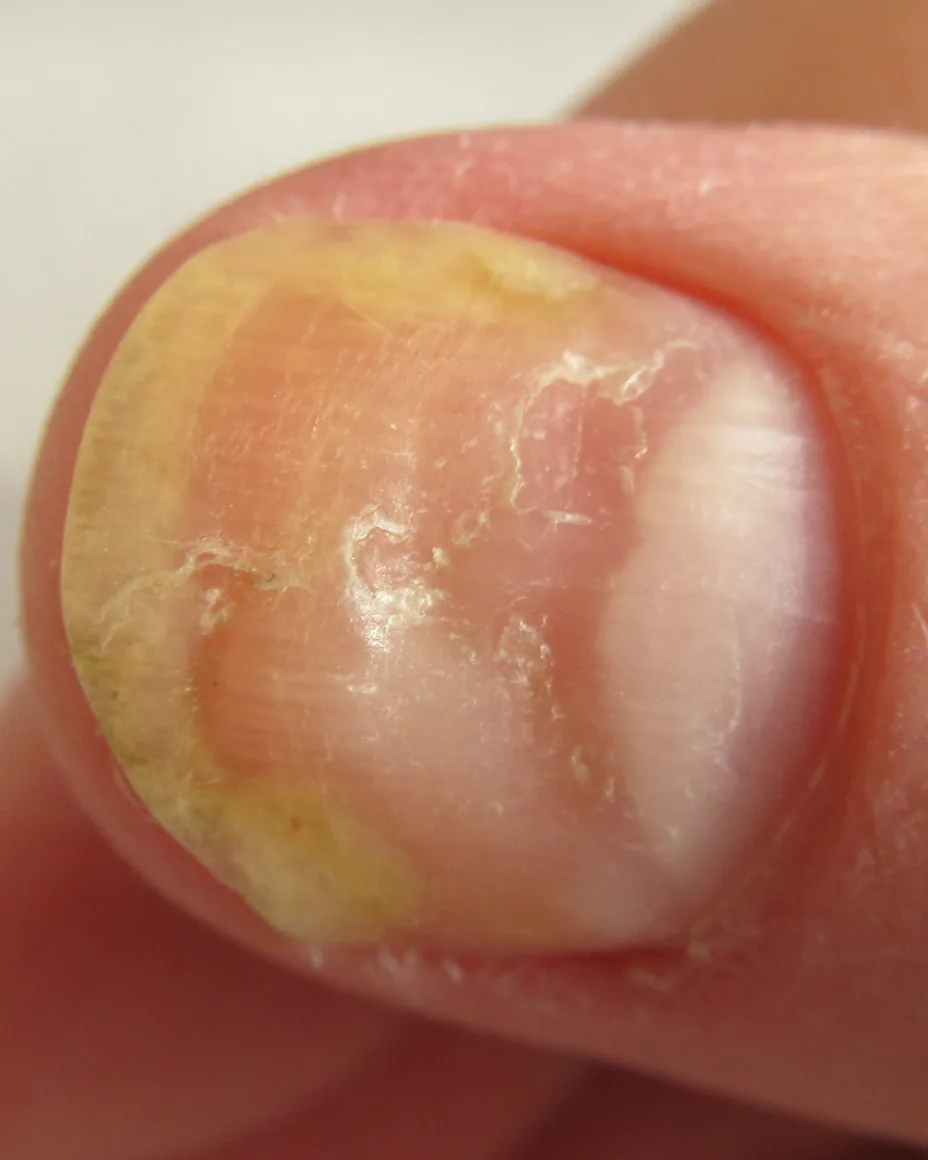
**Nail fungus, also called onychomycosis, is the most common.** [1] It causes color change, a brittle nail that cracks, splits or crumbles, buildup under the nail, lifting so the nail is no longer firmly attached, thickening, a misshapen nail, and sometimes pain. [2] Changes typically start at the tip and move toward the cuticle. Colors run from yellow and white through brown, orange and greenish-black. [2] On darker skin tones, a thickened nail is often brown, and the infected skin around the nail tends to be a bit darker than your natural skin tone. [2]
**Nails also carry signals from elsewhere.** Pitting can come from [psoriasis](/conditions/psoriasis/), atopic dermatitis or [alopecia areata](/conditions/alopecia/). Spoon-shaped nails are associated with iron deficiency. Yellow nails are associated with lung disease and rheumatoid arthritis. Curving of the nails is associated with disease in the lungs, heart, liver, stomach or intestine. Deep grooves mean something slowed or stopped nail growth. [4] None of that means a nail change is bad news; it means it is information worth reading properly.
**Changes worth having examined** [4]
- A dark streak in a nail, which is the important one
- A nail lifting away from the nail bed
- Redness and swelling around a nail
- A greenish-black color
- Pitting, deep grooves, spoon-shaped nails or clubbing
- Any change in a nail that swells or causes pain
A dark streak
The nail change to never watch at home. A brown or black band in a nail, often on the thumb or big toe, is the first sign of melanoma under the nail. [5] Found early, melanoma, even on the nails, is highly treatable. [5]
## What causes nail fungus, and how it spreads
### Contact, direct or shared
Nail fungus is contagious. It spreads through direct contact with infected nails or skin, and through shared towels and clippers. [1] It can also start from athlete's foot that has moved to a nail. It does not clear on its own. [1]
### Warm, damp, barefoot places
Walking barefoot in warm, moist shared spaces such as pools and locker rooms raises the risk. [1] So does anything that keeps a nail damp for long stretches, which is why it turns up more in people whose feet are in shoes all day and in people whose hands are in water.
### What makes it more stubborn
Diabetes, damaged blood vessels and a previous nail injury are the situations where a longer course, sometimes maintenance for a year, is part of the plan from the start. [3] That is worth knowing at the first visit so the plan matches the situation.
Under a microscope
How nail fungus is confirmed. Nail clippings or scrapings are examined to rule out other causes of the same appearance, including psoriasis and injury. [3] Treating an assumed fungus that is not one wastes months.
## What treating nail fungus actually takes
This is the honest timeline, and it is the reason so many people give up partway. Nail fungus is highly treatable with a dermatologist's help, and it is slow, because a nail can only grow at the speed a nail grows. [3]
| Route | How long it runs [3] |
| --- | --- |
| Topical solution applied to the nail | Usually 48 weeks |
| Oral treatment, fingernails | About 6 weeks |
| Oral treatment, toenails | About 12 weeks |
| Waiting for the nail to fully grow out | A year or longer, whatever the treatment |
| If a nail is removed, fingernail regrowth | 6 months or longer |
| If a nail is removed, toenail regrowth | 12 to 18 months |
**The most important thing on that table is the last column of the fourth row.** Even when the fungus is gone, the nail you can see is still the old damaged one until it has grown out entirely, and that takes a year or more. People stop treatment at month four because the nail still looks bad, and the nail still looks bad because nails are slow.
## What different nail changes point at
| What you see | What it can indicate [4] |
| --- | --- |
| A dark streak in the nail | **Melanoma. This is the one to bring in rather than watch** [4] [5] |
| The nail lifting away from the bed | Fungal infection, psoriasis, or injury |
| Redness and swelling around the nail | Infection around the nail |
| Greenish-black discoloration | A bacterial nail infection |
| Pitting, meaning tiny dents | Psoriasis, atopic dermatitis or alopecia areata |
| Yellow nails | Associated with lung disease and rheumatoid arthritis |
| Deep grooves or gaps across the nail | Something slowed or stopped nail growth |
| Spoon-shaped nails | Associated with iron deficiency |
| Curving nails, or clubbing | Associated with disease in the lungs, heart, liver, stomach or intestine |
**This table is not a diagnostic tool and it is not meant to be read as one.** Most nail changes turn out to be ordinary. What it is for is the last line of the section: if your nails change, swell or cause pain, see a dermatologist, because these can be signs of serious nail problems. [4]
> Dr. Kilcline and her staff are amazing to work with...everyone is always so friendly!
— **Brittany M.**, San Luis Obispo (5 out of 5 stars)
The Coastal difference
## The dark streak is why this is a dermatology appointment
Almost everything on this page is ordinary. One thing is not. **A brown or black band in a nail, often on the thumb or big toe, is the first sign of melanoma under the nail**, and the other signs are darkened skin near the nail, the nail separating from the bed, a crack down the center, or a bump under the nail. [5] Nail melanoma is more common in older people and **in people with skin of color**, and prior nail trauma is a risk factor. [5]
The reason that belongs on a nail page rather than a skin cancer page is that people bring dark streaks to a nail salon, a podiatrist or nobody at all, and treat them as bruises. **Found early, melanoma, even on the nails, is highly treatable.** [5] Where a nail change needs an answer rather than a treatment, [a small sample sent to a laboratory](/treatments/skin-cancer-diagnosis/) gives one, here, usually at the same visit. That is the whole argument for this appointment, and everything else on the page is the ordinary work that comes with it.
Highly treatable
What melanoma is, including on the nails, when it is found early. [5] Which is the entire reason a new dark streak gets looked at rather than watched.
## When to see a dermatologist
**Book an appointment straight if you notice:**
- A new dark band or streak in a nail. [5] This is the one that does not wait
- Darkened skin next to a nail, a nail separating from its bed, a crack down the center of a nail, or a bump under a nail [5]
**Book an appointment if:**
- A nail is thickening, discoloring, crumbling or lifting [2]
- You have tried an over-the-counter nail treatment without result
- A nail or the skin around it is red, swollen or painful [4]
- Your nails have developed pitting, grooves, spooning or curving [4]
- You have an ingrown toenail, particularly one that is sore or infected [6]
If your nails change, swell or cause pain, see your dermatologist, because these can be signs of serious nail problems. [4] Diagnosis usually involves an examination plus nail clippings or scrapings examined under a microscope. [3]
## Taking care of nails
**Worth doing** [6] [7]
- Cut nails straight across, using sharp scissors or clippers, rounding slightly at the tips for strength. That is also how ingrown toenails are avoided [6] [7]
- Do not dig out an ingrown toenail, especially if it is infected and sore. That is an appointment rather than a project [6]
- Keep feet dry, change socks when they are damp, and wear something on your feet in pools, locker rooms and communal showers [1]
- Do not share clippers, files or towels, since nail fungus spreads that way [1]
- Give a treatment its full run. Stopping at month four because the nail still looks bad is the most common way this goes wrong
**Worth knowing**
- Nail fungus is contagious, to other people and to your own other nails [1]
- It does not clear on its own [1]
- A dark streak in a nail is never something to monitor at home [4] [5]
## Treatments we offer
Diagnosis, prescription treatment, and where a nail change needs an answer rather than a treatment, the test that gives one. Pick a treatment to see how it works.
- [Skin Cancer Diagnosis](https://coastaldermaesthetics.com/treatments/skin-cancer-diagnosis/)
- [Skin Care Consultations](https://coastaldermaesthetics.com/treatments/skin-care-consultations/)
## What treatment costs
Diagnosis and treatment of nail conditions are medical care rather than a cosmetic service, and are handled differently from the aesthetic treatments on this site. Our office will go through what applies to you when you book.
Where nail clippings or a small sample are sent for examination, laboratory fees are billed separately by the laboratory, and we will tell you when anything is being sent.
The most common one
Nail fungus, also called onychomycosis, which affects toenails and fingernails [1]
How it is diagnosed
Examination plus nail clippings or scrapings viewed under a microscope [3]
The realistic timeline
Oral treatment runs 6 weeks for fingernails and 12 for toenails, and a nail takes a year or longer to fully grow out [3]
The one to never ignore
A new dark streak in a nail [4] [5]
## Nail disorders frequently asked questions
**Q: How long does nail fungus take to treat?**
Longer than most people expect, and the treatment and the appearance run on different clocks. Topical solution usually runs 48 weeks. Oral treatment runs about six weeks for fingernails and twelve for toenails. And a nail takes a year or longer to completely grow out, whatever the treatment, so the nail keeps looking damaged after the infection is handled. [3] The timeline table above sets it all out.
**Q: What is the dark line in my nail?**
Have it looked at. A brown or black band in a nail, often on the thumb or big toe, is the first sign of melanoma under the nail. [5] Most dark lines turn out to be something else, and this is the single nail change that is not worth monitoring at home. Found early, melanoma, even on the nails, is highly treatable. [5]
**Q: Can a dermatologist treat an ingrown toenail?**
Yes, and it is worth going rather than digging. The guidance is direct: avoid digging out ingrown toenails, especially if they are infected and sore, and see a dermatologist for treatment. [6] Cutting nails straight across is what prevents the next one. [6] [7]
**Q: Can my nails really show other health problems?**
Sometimes. Pitting is associated with psoriasis, atopic dermatitis and alopecia areata; spooning with iron deficiency; yellow nails with lung disease and rheumatoid arthritis; curving with disease in several organs. [4] Most nail changes are ordinary. The value is in having somebody who knows the difference look at them.
**Q: Do I need a referral?**
Yes. This is medical dermatology, and the practice is currently accepting new medical patients by referral from your primary care physician. Once you have that, call the office and we will get you in.
A year or longer
How long a nail takes to completely grow out, whatever the treatment. [3] Which is why a nail can still look damaged months after the infection itself has been dealt with.
## Offered at
- [San Luis Obispo](https://coastaldermaesthetics.com/locations/coastal-dermatology-aesthetics/)
## Something changed in a nail? Request an appointment
## Sources and medical review
1. American Academy of Dermatology Association. "Nail fungus: FAQs." States that "nail fungus, also called onychomycosis, is a fungal infection that can affect both your toenails and fingernails," that it is contagious through direct contact with infected nails or skin and through shared towels and clippers, that walking barefoot in warm moist shared places raises the risk, that it can arise from athlete's foot, and that it does not clear on its own. [https://www.aad.org/public/diseases/a-z/nail-fungus-overview](https://www.aad.org/public/diseases/a-z/nail-fungus-overview) · Medical Organization
2. American Academy of Dermatology Association. "Nail fungus: Signs and symptoms." Names "color change," "brittle nail that cracks, splits, or crumbles," "buildup under a nail," "lifting, so the nail is no longer firmly attached," "thickened nail," "misshapen nail or nail falls off" and "pain." States that changes tend to start at the tip and move toward the cuticle, that colors include yellow, brown, white, orange and greenish-black, that a "thickened nail is often brown," and that "if you have a darker skin tone, infected skin around the nail tends to be a bit darker than your natural skin tone." [https://www.aad.org/public/diseases/a-z/nail-fungus-symptoms](https://www.aad.org/public/diseases/a-z/nail-fungus-symptoms) · Medical Organization
3. American Academy of Dermatology Association. "Nail fungus: Diagnosis and treatment." Describes diagnosis by examination for "color change, buildup beneath a nail, and other signs of nail fungus" plus nail clippings or scrapings viewed "under a microscope" to rule out psoriasis or injury. Gives treatment durations of "usually for 48 weeks" for efinaconazole and tavaborole topical solutions, "6 weeks" for terbinafine for fingernails and "12 weeks" for toenails, and "12 weeks" for itraconazole for toenails; states it takes "a year or longer for your nail to completely grow out," and that after nail removal fingernail regrowth takes "6 months or longer" and toenail regrowth "12 to 18 months." States that "with a dermatologist's help, nail fungus is highly treatable," and that maintenance therapy may run "for a year or longer" particularly with diabetes, damaged blood vessels or previous nail injury. [https://www.aad.org/public/diseases/a-z/nail-fungus-treatment](https://www.aad.org/public/diseases/a-z/nail-fungus-treatment) · Medical Organization
4. American Academy of Dermatology Association. "12 nail changes a dermatologist should examine." Names a dark streak, which "could be melanoma, the most serious type of skin cancer"; nail lifting up; redness and swelling around a nail; greenish black color from bacterial infection; pitted nails, associated with psoriasis, atopic dermatitis and alopecia areata; yellow nails, associated with "lung disease and rheumatoid arthritis"; deep grooves or gaps, meaning "something slowed (or stopped) your nails from growing"; thick overgrown nails; spoon-shaped nails, associated with iron deficiency; washboard nails; curved nails or clubbing, associated with disease in the "lungs, heart, liver, stomach or intestine"; and color changes. States that "if your nails change, swell, or cause pain, see your dermatologist because these can be signs of serious nail problems." [https://www.aad.org/public/everyday-care/nail-care-secrets/basics/nail-changes-dermatologist-should-examine](https://www.aad.org/public/everyday-care/nail-care-secrets/basics/nail-changes-dermatologist-should-examine) · Medical Organization
5. American Academy of Dermatology Association. "How to check your nails for melanoma." Names five signs: a dark streak, described as a brown or black band in the nail, often on the thumb or big toe; darkened skin near the nail; nail separation from the nail bed; nail splitting down the center; and bumps or nodules under the nail. States that nail melanoma "is more common in older individuals and people with skin of color," names personal or family melanoma history and prior nail trauma among risks, states that melanoma found early, including on the nails, is "highly treatable," and advises that "if you notice any changes to your nails, including a new dark band on your nail, make an appointment to see a board-certified dermatologist." [https://www.aad.org/public/diseases/skin-cancer/types/common/melanoma/nail-melanoma](https://www.aad.org/public/diseases/skin-cancer/types/common/melanoma/nail-melanoma) · Medical Organization
6. American Academy of Dermatology Association. "11 dermatologists' tips for healthy nails." States "to reduce your chances of getting an ingrown toenail, cut straight across when trimming your toenails," and advises to "avoid 'digging out' ingrown toenails, especially if they are infected and sore. If you are suffering from an ingrown toenail, see a dermatologist for treatment." [https://www.aad.org/public/everyday-care/nail-care-secrets/basics/healthy-nail-tips](https://www.aad.org/public/everyday-care/nail-care-secrets/basics/healthy-nail-tips) · Medical Organization
7. American Academy of Dermatology Association. "How to trim your nails." States "cut nails straight across. Use sharp nail scissors or clippers. Round the nails slightly at the tips for maximum strength." [https://www.aad.org/public/everyday-care/nail-care-secrets/basics/how-to-trim-nails](https://www.aad.org/public/everyday-care/nail-care-secrets/basics/how-to-trim-nails) · Medical Organization
Content on this page is for educational purposes and is not a substitute for professional medical advice, diagnosis or treatment. The associations listed on this page describe conditions that can produce particular nail changes; they do not establish that any individual has any condition, and most nail changes are not serious. A new dark streak in a nail should be examined by a board-certified dermatologist rather than monitored at home. Nail fungus is confirmed by laboratory examination, and treatment is slow because nails grow slowly; recurrence is possible. Oral and topical antifungal treatments carry their own risks, which are discussed before treatment. Individual results may vary.
```ld+json
{
"@context": "https://schema.org",
"@graph": [
{
"@context": "https://schema.org",
"@type": "MedicalCondition",
"@id": "https://coastaldermaesthetics.com/conditions/nail-disorders/#concern",
"name": "Nail Disorders",
"url": "https://coastaldermaesthetics.com/conditions/nail-disorders/",
"description": "Nails are easy to write off as cosmetic and they are one of the more informative surfaces on the body. Fungal infection is the most common reason people come in, several other conditions show up in nails first, and one nail change should never be wat…",
"image": {
"@type": "ImageObject",
"contentUrl": "https://coastaldermaesthetics.com/wp-content/uploads/2026/07/nail-disorders-2x-1024x512.jpg",
"width": 1024,
"height": 512,
"caption": "a nail disorder in the thumb"
},
"possibleTreatment": [
{
"@type": "MedicalTherapy",
"name": "Skin Cancer Diagnosis",
"url": "https://coastaldermaesthetics.com/treatments/skin-cancer-diagnosis/"
},
{
"@type": "MedicalTherapy",
"name": "Skin Care Consultations",
"url": "https://coastaldermaesthetics.com/treatments/skin-care-consultations/"
}
]
},
{
"@context": "https://schema.org",
"@type": "MedicalWebPage",
"@id": "https://coastaldermaesthetics.com/conditions/nail-disorders/#webpage",
"name": "Nail Disorders",
"url": "https://coastaldermaesthetics.com/conditions/nail-disorders/",
"mainEntity": {
"@id": "https://coastaldermaesthetics.com/conditions/nail-disorders/#concern"
},
"lastReviewed": "2026-08-01",
"reviewedBy": {
"@type": "Person",
"@id": "https://coastaldermaesthetics.com/providers/dr-christine-kilcline/#provider",
"name": "Dr. Christine Kilcline",
"url": "https://coastaldermaesthetics.com/providers/dr-christine-kilcline/"
},
"mentions": [
{
"@type": "MedicalCondition",
"name": "Melanoma",
"sameAs": "https://www.wikidata.org/wiki/Q180614"
}
],
"about": [
{
"@type": "MedicalSpecialty",
"name": "Dermatology",
"sameAs": "https://www.wikidata.org/wiki/Q171171"
},
{
"@type": "MedicalCondition",
"name": "Onychomycosis",
"sameAs": "https://www.wikidata.org/wiki/Q917620"
}
],
"speakable": {
"@type": "SpeakableSpecification",
"cssSelector": [
".geo-summary"
]
}
},
{
"@context": "https://schema.org",
"@type": "BreadcrumbList",
"itemListElement": [
{
"@type": "ListItem",
"position": 1,
"name": "Home",
"item": {
"@id": "https://coastaldermaesthetics.com/",
"@type": "WebSite",
"name": "Home"
}
},
{
"@type": "ListItem",
"position": 2,
"name": "Concerns",
"item": {
"@id": "https://coastaldermaesthetics.com/conditions/",
"@type": "CollectionPage",
"name": "Concerns"
}
},
{
"@type": "ListItem",
"position": 3,
"name": "Nail Disorders",
"item": "https://coastaldermaesthetics.com/conditions/nail-disorders/"
}
]
},
{
"@context": "https://schema.org",
"@type": "Question",
"name": "Nail Disorders",
"acceptedAnswer": {
"@type": "Answer",
"text": "Nail disorders cover fungal infection, ingrown nails, and nail changes that reflect a skin condition or a wider health issue. Nail fungus, also called onychomycosis, is the most common. Nail concerns are diagnosed and treated at Coastal Dermatology + Aesthetics in San Luis Obispo."
},
"isPartOf": {
"@id": "https://coastaldermaesthetics.com/conditions/nail-disorders/#webpage"
},
"url": "https://coastaldermaesthetics.com/conditions/nail-disorders/"
},
{
"@context": "https://schema.org",
"@type": "Review",
"reviewBody": "Dr. Kilcline and her staff are amazing to work with...everyone is always so friendly!",
"itemReviewed": {
"@type": "Organization",
"@id": "https://coastaldermaesthetics.com/#organization",
"name": "Coastal Dermatology + Aesthetics"
},
"author": {
"@type": "Person",
"name": "Brittany M."
},
"reviewRating": {
"@type": "Rating",
"ratingValue": 5,
"bestRating": 5
}
},
{
"@context": "https://schema.org",
"@type": "FAQPage",
"mainEntity": [
{
"@type": "Question",
"name": "How long does nail fungus take to treat?",
"acceptedAnswer": {
"@type": "Answer",
"text": "Longer than most people expect, and the treatment and the appearance run on different clocks. Topical solution usually runs 48 weeks. Oral treatment runs about six weeks for fingernails and twelve for toenails. And a nail takes a year or longer to completely grow out, whatever the treatment, so the nail keeps looking damaged after the infection is handled. [3] The timeline table above sets it all out.
"
}
},
{
"@type": "Question",
"name": "What is the dark line in my nail?",
"acceptedAnswer": {
"@type": "Answer",
"text": "Have it looked at. A brown or black band in a nail, often on the thumb or big toe, is the first sign of melanoma under the nail. [5] Most dark lines turn out to be something else, and this is the single nail change that is not worth monitoring at home. Found early, melanoma, even on the nails, is highly treatable. [5]
"
}
},
{
"@type": "Question",
"name": "Can a dermatologist treat an ingrown toenail?",
"acceptedAnswer": {
"@type": "Answer",
"text": "Yes, and it is worth going rather than digging. The guidance is direct: avoid digging out ingrown toenails, especially if they are infected and sore, and see a dermatologist for treatment. [6] Cutting nails straight across is what prevents the next one. [6] [7]
"
}
},
{
"@type": "Question",
"name": "Can my nails really show other health problems?",
"acceptedAnswer": {
"@type": "Answer",
"text": "Sometimes. Pitting is associated with psoriasis, atopic dermatitis and alopecia areata; spooning with iron deficiency; yellow nails with lung disease and rheumatoid arthritis; curving with disease in several organs. [4] Most nail changes are ordinary. The value is in having somebody who knows the difference look at them.
"
}
},
{
"@type": "Question",
"name": "Do I need a referral?",
"acceptedAnswer": {
"@type": "Answer",
"text": "Yes. This is medical dermatology, and the practice is currently accepting new medical patients by referral from your primary care physician. Once you have that, call the office and we will get you in.
"
}
}
]
}
]
}
```