---
title: "Actinic Keratosis"
---
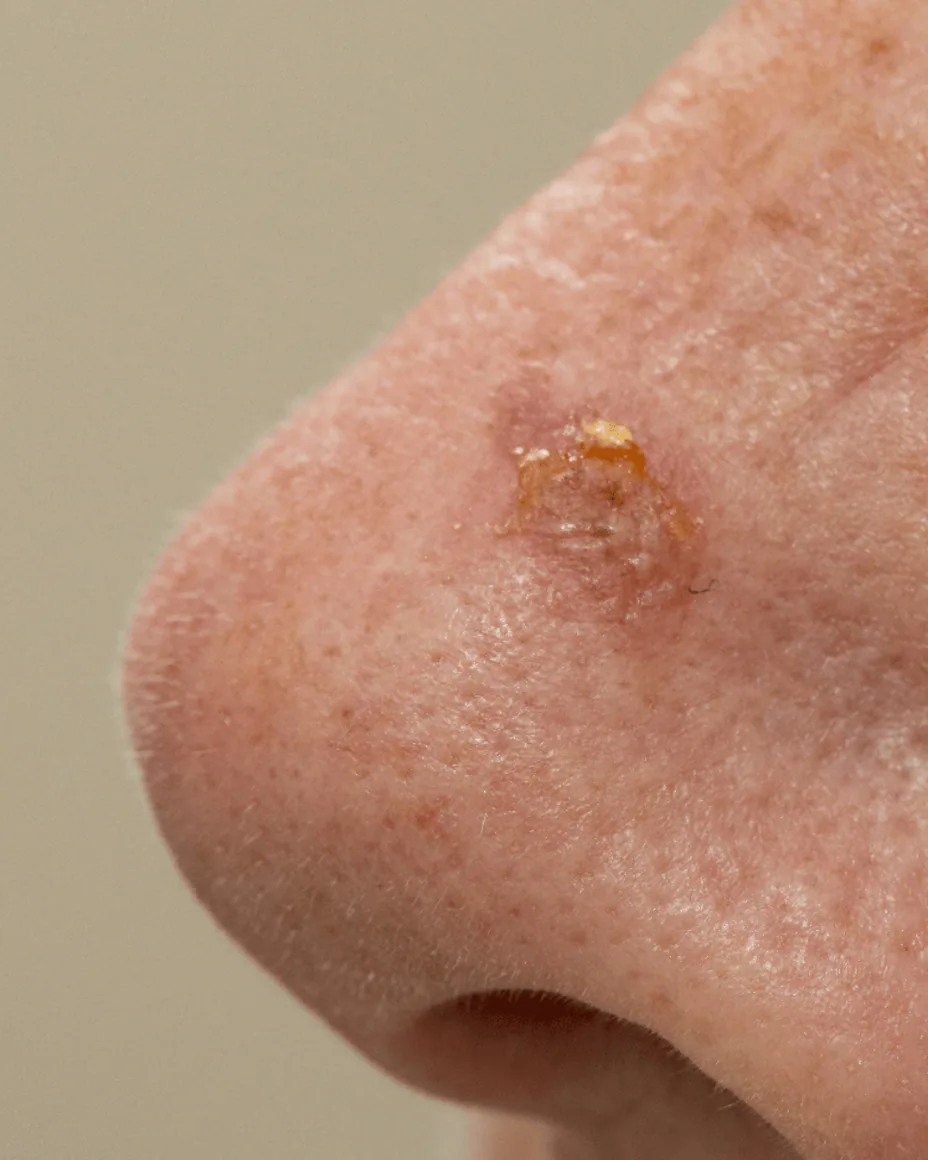
An actinic keratosis is a small area of skin where years of ultraviolet light have changed how the cells behave. It shows up as a rough, dry, scaly patch, and its most reliable feature is not how it looks but how it feels: like fine sandpaper on skin that is otherwise smooth. Most people find their first one while washing their face or running a hand over a forearm.
They can look like a reddish spot, a new age spot, a pimple, or a patch of irritated skin, which is exactly why they are so easy to dismiss. [2] On a lip they look like a chapped lip that will not settle, and that version has its own name, actinic cheilitis. [2] They are also rarely solitary. The sun that produced one landed on a whole area, so where there is one there are usually several, including some that have not surfaced yet.
Precancerous means what it says: an actinic keratosis is not a cancer, and some of them turn into a type of [skin cancer](/conditions/skin-cancer/) called squamous cell carcinoma. [2] The practical version of that sentence is the reason this page exists. Found at this stage, these are treated. That is a much better position than the alternative, and it is entirely available to anyone who books.
**What people usually notice first**
- A rough patch that flakes off and comes back in the same place
- Something you can feel more easily than you can see
- A reddish or scaly spot that looks a bit like irritated skin [2]
- A lip that stays chapped no matter what you put on it [2]
- Several of them at once, across an area that has had a lot of sun
These four turn up on the same sun-exposed skin and get mistaken for one another constantly. Texture is the quickest way to separate them, and so is what happens over the following month. This narrows it down. It does not replace an examination, and an actinic keratosis can look like a new age spot or a patch of irritated skin. [2]
Actinic keratosisAge spotDry patchSeborrheic keratosisHow it feelsRough, like fine sandpaper, on skin that is otherwise smoothFlat and smooth, level with the skin around itRough all over while dry, smooth once moisturizedRaised and waxy, with a stuck-on-the-skin look [3]What it looks likeA reddish or scaly spot, sometimes mistaken for a new age spot, a pimple or irritated skin [2]An even tan or brown mark with a clear edgeFine flaking, often over a wider area than one spotBrown, though the range runs from white to black, often warty on the surface [3]Where it turns upFace, ears, balding scalp, hands, neck or lips [2]The same sun-exposed skinAnywhere, and it follows the seasonChest, back, stomach, scalp, face or neck, but never the palms or soles [3]What it does nextFlakes off, then returns in the same placeStays as it isSettles with moisturizer and stays settledThickens slowly and stays benign [3]Worth an appointmentYesIf it changesNoIf it changes, itches or catches on clothing
The single most useful test is the one-month one. Something that flakes away and then comes back in exactly the same spot is behaving like an actinic keratosis, whatever it looks like. That is the one to bring in. Where an examination cannot settle it, [a biopsy](/treatments/skin-cancer-diagnosis/) does, usually at the same visit.
AreaWhy it matters hereFace, forehead and noseThe most consistently exposed skin on the body, and where most people find their first one. [2]EarsEasy to miss entirely, and the top edge of the ear takes sun from directly above all day.Balding or thinning scalpOne of the most common sites, and almost impossible to check yourself. [2]LipsWhere the same growth is called actinic cheilitis, and where it is mistaken for chapping. [2]Neck and chestDecades of Central Coast sun concentrate here, usually from a long time ago.Backs of the hands and forearmsSteady exposure through a car window, year after year, on skin nobody thinks to protect.
Freezing off the patches you can feel deals with the patches you can feel. The sun that produced them landed on a whole region of skin, and the rest of that region is still there. [Photodynamic therapy](/treatments/photodynamic-therapy/) treats the area rather than the spots, which is why it suits people who keep finding new ones on the same forehead, scalp or forearm. It is performed on site at our San Luis Obispo office.
The other half of the visit is the part you cannot do at home. Telling an actinic keratosis from an early squamous cell carcinoma is a judgment made by a board-certified dermatologist looking at your skin, and where looking is not enough, [a biopsy](/treatments/skin-cancer-diagnosis/) settles it here rather than somewhere else. The same examination also checks for signs of skin cancer elsewhere, which means one appointment answers both questions. [1]
**Book an appointment if you notice:**
- A rough patch that keeps coming back in the same place after it flakes off
- Something you can feel more clearly than you can see
- A scaly or reddish spot that has been there more than a few weeks [2]
- A lip that stays chapped and rough whatever you put on it [2]
- Several rough spots across one area of sun-exposed skin
**Worth booking if:**
- You have had actinic keratoses before, since new ones are common in the same skin
- You have spent years outdoors on the Central Coast and have never had a skin exam
- You have fair skin that burns easily, or you used tanning beds at any point
- You take a medication that suppresses your immune system
If you are not sure whether a rough spot is worth an appointment, book it. Sorting that out is exactly what the visit is for, and it is far easier to do at this stage than at any later one.
Treatment clears what is on your skin now. What keeps the count down afterward is the sun you get from here, and on the Central Coast that is the part worth being deliberate about.
**Worth doing**
- Broad-spectrum sunscreen, SPF 30 or higher, water resistant, every day before you go outside [4]
- Reapply every two hours outdoors, and after swimming or sweating [4]
- A hat with a brim, which covers the scalp, ears and nose all at once
- Daily sun protection taken consistently, for people who are outdoors a lot and want another layer
- Run a hand over your forehead, scalp, ears and forearms every month or so, and bring in anything that comes back
**Worth knowing**
- Overcast days still deliver ultraviolet light, which the marine layer does not change
- New patches can appear in skin that has already had a lot of sun, so a check every so often is normal rather than a sign anything went wrong
- Treating the area rather than the spots is what suits people who keep finding new ones
- Your lips need sun protection too, and most sunscreen routines skip them
Diagnosis, treatment and the sun protection that keeps new ones down, in one practice. Pick a treatment to see how it works.
Diagnosis and treatment of actinic keratoses are medical care rather than a cosmetic service, and are handled differently from the aesthetic treatments on this site. Our office will go through what applies to you when you book.
Where a biopsy is taken, laboratory fees are billed separately by the laboratory that examines the sample, and we will tell you when a sample is being sent.
**Q: Is an actinic keratosis cancer?**
No. It is a precancerous growth, which means it is a change in the skin rather than a cancer. Some actinic keratoses turn into a type of skin cancer called squamous cell carcinoma, which is why they are treated. [2] Found at this stage they are dealt with, and that is the whole advantage of catching them.
**Q: How do I tell one from an age spot or a dry patch?**
Mostly by feel, and by what it does next. An actinic keratosis is rough like fine sandpaper on skin that is otherwise smooth, and it comes back in the same place after it flakes off. An age spot is flat and stays put. A dry patch settles with moisturizer. The comparison above sets all four out side by side.
**Q: How are they treated?**
That depends on how many you have and where they are. In-office procedures suit one or a few, including cryosurgery and photodynamic therapy, and prescription creams applied at home suit skin that has many. [1] Photodynamic therapy is performed at our San Luis Obispo office and treats a whole sun-damaged area rather than individual spots. Your dermatologist recommends the approach after examining your skin.
**Q: What does photodynamic therapy involve?**
A solution goes on the treated area and stays there for about 60 to 90 minutes, then a light is used to activate it. [1] Most patients need two treatments a few weeks apart. [1] For 48 hours afterward you need to stay out of daylight completely, including through a window and on a cloudy day, because treated skin is highly sensitive to light during that window. [1] Plan the two days before you book.
**Q: Will they come back?**
New ones can appear in skin that has already had a lot of sun, and that is expected rather than a sign that treatment failed. Sunscreen, a hat and a check every so often are what keep the count down. [4] It is far easier to clear a few new patches than to catch up after several years.
**Q: Do I need a referral?**
Yes. This is medical dermatology, and the practice is currently accepting new medical patients by referral from your primary care physician. Once you have that, call the office and we will get you in.
1. American Academy of Dermatology Association. "Actinic keratosis: Diagnosis and treatment." States that a board-certified dermatologist can "often diagnose you by looking carefully at your skin," that during the examination the dermatologist also checks for signs of skin cancer, that treatment "can reduce your risk of developing skin cancer," names cryosurgery, chemical peels, curettage, photodynamic therapy and laser resurfacing as in-office procedures for one or a few AKs and 5-fluorouracil cream, diclofenac sodium gel, imiquimod cream and tirbanibulin ointment as at-home medications where there are many, states that during photodynamic therapy "a solution that makes your skin extremely sensitive to light is applied to the area with AKs. You'll sit in the office with this on your skin for about 60 to 90 minutes. Afterward, you'll be treated with either a blue or red light," that "for 48 hours after treatment, you'll need to avoid the outdoors during daylight. The UV light, even on a cloudy or snowy day, can cause a serious skin reaction," and that "most patients with AKs need 2 PDT treatments, with the second treatment given 3 weeks after the first." [https://www.aad.org/public/diseases/skin-cancer/actinic-keratosis-treatment](https://www.aad.org/public/diseases/skin-cancer/actinic-keratosis-treatment) · Medical Organization
2. American Academy of Dermatology Association. "Actinic keratosis: Overview." Describes an actinic keratosis as "a precancerous skin growth caused by the sun or indoor tanning," also called a solar keratosis, states that it "often appears as a reddish spot" and can "look like a new age spot, pimple, or patch of irritated skin," that these growths "tend to appear on skin that's been the most badly damaged by the sun" including "the face, ears, balding scalp, hands, neck, or lips," that "when an AK forms on a lip, the medical name for this precancerous growth is actinic cheilitis" and that on the lips it "can look like a badly chapped lip," that "it is estimated that more than 40 million Americans develop actinic keratoses (AKs) each year," and that "some AKs and actinic cheilitis turn into a type of skin cancer called squamous cell carcinoma." [https://www.aad.org/public/diseases/skin-cancer/actinic-keratosis-overview](https://www.aad.org/public/diseases/skin-cancer/actinic-keratosis-overview) · Medical Organization
3. American Academy of Dermatology Association. "Seborrheic keratoses: Signs and symptoms." States that seborrheic keratoses "have a waxy, stuck-on-the-skin look," "can look like stucco splattered on the skin," are usually brown "though they range in color from white to black," "start as small, rough bumps, then slowly thicken and develop a warty surface," "form on the chest, back, stomach, scalp, face, neck, or other parts of the body (but not on the palms and soles)," and "cause no pain, though some itch." [https://www.aad.org/public/diseases/a-z/seborrheic-keratoses-symptoms](https://www.aad.org/public/diseases/a-z/seborrheic-keratoses-symptoms) · Medical Organization
4. American Academy of Dermatology Association. "How to select a sunscreen." Broad spectrum, SPF 30 or higher, water resistant, reapplied every two hours outdoors and after swimming or sweating. [https://www.aad.org/public/everyday-care/sun-protection/shade-clothing-sunscreen/how-to-select-sunscreen](https://www.aad.org/public/everyday-care/sun-protection/shade-clothing-sunscreen/how-to-select-sunscreen) · Medical Organization
Content on this page is for educational purposes and is not a substitute for professional medical advice, diagnosis or treatment. Not every rough or scaly patch is an actinic keratosis, and appearance alone does not establish what a growth is; diagnosis is made by examination, with a biopsy where the appearance is not clear-cut. Treatment choice depends on the number, size and location of the growths. Where photodynamic therapy is used, treated skin is highly sensitive to light for approximately 48 hours afterward and must be kept out of daylight during that period, and redness, swelling and peeling across the treated area for several days are expected. Individual results may vary.
```ld+json
{
"@context": "https://schema.org",
"@graph": [
{
"@context": "https://schema.org",
"@type": "MedicalCondition",
"@id": "https://coastaldermaesthetics.com/conditions/actinic-keratosis/#concern",
"name": "Actinic Keratosis",
"url": "https://coastaldermaesthetics.com/conditions/actinic-keratosis/",
"description": "Actinic keratoses are the rough, dry patches that years of sun leave behind, and most people find them with a hand rather than a mirror. Precancerous is the word for them, and it is the useful word: it means this has been caught at the stage a dermat…",
"image": {
"@type": "ImageObject",
"contentUrl": "https://coastaldermaesthetics.com/wp-content/uploads/2026/08/actinic-keratosis-2x-1024x512.jpg",
"width": 1024,
"height": 512,
"caption": "Woman with actinic keratosis"
},
"possibleTreatment": [
{
"@type": "MedicalTherapy",
"name": "Heliocare®",
"url": "https://coastaldermaesthetics.com/treatments/heliocare/"
},
{
"@type": "MedicalTherapy",
"name": "Photodynamic Therapy",
"url": "https://coastaldermaesthetics.com/treatments/photodynamic-therapy/"
},
{
"@type": "MedicalTherapy",
"name": "Skin Cancer Surgery & Mohs Referrals",
"url": "https://coastaldermaesthetics.com/treatments/cancer-surgery-mohs-referrals/"
},
{
"@type": "MedicalTherapy",
"name": "Skin Cancer Diagnosis",
"url": "https://coastaldermaesthetics.com/treatments/skin-cancer-diagnosis/"
},
{
"@type": "MedicalTherapy",
"name": "Skin Care Consultations",
"url": "https://coastaldermaesthetics.com/treatments/skin-care-consultations/"
}
]
},
{
"@context": "https://schema.org",
"@type": "MedicalWebPage",
"@id": "https://coastaldermaesthetics.com/conditions/actinic-keratosis/#webpage",
"name": "Actinic Keratosis",
"url": "https://coastaldermaesthetics.com/conditions/actinic-keratosis/",
"mainEntity": {
"@id": "https://coastaldermaesthetics.com/conditions/actinic-keratosis/#concern"
},
"lastReviewed": "2026-08-01",
"mentions": [
{
"@type": "MedicalCondition",
"name": "Cutaneous squamous-cell carcinoma",
"sameAs": "https://www.wikidata.org/wiki/Q5749018"
}
],
"about": [
{
"@type": "MedicalSpecialty",
"name": "Dermatology",
"sameAs": "https://www.wikidata.org/wiki/Q171171"
},
{
"@type": "MedicalCondition",
"name": "Actinic keratosis",
"sameAs": "https://www.wikidata.org/wiki/Q422225"
}
],
"speakable": {
"@type": "SpeakableSpecification",
"cssSelector": [
".geo-summary"
]
}
},
{
"@context": "https://schema.org",
"@type": "BreadcrumbList",
"itemListElement": [
{
"@type": "ListItem",
"position": 1,
"name": "Home",
"item": {
"@id": "https://coastaldermaesthetics.com/",
"@type": "WebSite",
"name": "Home"
}
},
{
"@type": "ListItem",
"position": 2,
"name": "Concerns",
"item": {
"@id": "https://coastaldermaesthetics.com/conditions/",
"@type": "CollectionPage",
"name": "Concerns"
}
},
{
"@type": "ListItem",
"position": 3,
"name": "Actinic Keratosis",
"item": "https://coastaldermaesthetics.com/conditions/actinic-keratosis/"
}
]
},
{
"@context": "https://schema.org",
"@type": "Question",
"name": "Actinic Keratosis",
"acceptedAnswer": {
"@type": "Answer",
"text": "An actinic keratosis is a precancerous skin growth caused by ultraviolet light from the sun or indoor tanning, usually appearing as a rough, dry, scaly patch that is easier to feel than to see. Coastal Dermatology + Aesthetics diagnoses and treats actinic keratoses at its San Luis Obispo office."
},
"isPartOf": {
"@id": "https://coastaldermaesthetics.com/conditions/actinic-keratosis/#webpage"
},
"url": "https://coastaldermaesthetics.com/conditions/actinic-keratosis/"
},
{
"@context": "https://schema.org",
"@type": "Review",
"reviewBody": "The staff is terrific, front to back. Thank you, Dr. Kilcline, for the great work today.",
"itemReviewed": {
"@type": "Organization",
"@id": "https://coastaldermaesthetics.com/#organization",
"name": "Coastal Dermatology + Aesthetics"
},
"author": {
"@type": "Person",
"name": "Steve P."
},
"reviewRating": {
"@type": "Rating",
"ratingValue": 5,
"bestRating": 5
}
},
{
"@context": "https://schema.org",
"@type": "FAQPage",
"mainEntity": [
{
"@type": "Question",
"name": "Is an actinic keratosis cancer?",
"acceptedAnswer": {
"@type": "Answer",
"text": "No. It is a precancerous growth, which means it is a change in the skin rather than a cancer. Some actinic keratoses turn into a type of skin cancer called squamous cell carcinoma, which is why they are treated. [2] Found at this stage they are dealt with, and that is the whole advantage of catching them.
"
}
},
{
"@type": "Question",
"name": "How do I tell one from an age spot or a dry patch?",
"acceptedAnswer": {
"@type": "Answer",
"text": "Mostly by feel, and by what it does next. An actinic keratosis is rough like fine sandpaper on skin that is otherwise smooth, and it comes back in the same place after it flakes off. An age spot is flat and stays put. A dry patch settles with moisturizer. The comparison above sets all four out side by side.
"
}
},
{
"@type": "Question",
"name": "How are they treated?",
"acceptedAnswer": {
"@type": "Answer",
"text": "That depends on how many you have and where they are. In-office procedures suit one or a few, including cryosurgery and photodynamic therapy, and prescription creams applied at home suit skin that has many. [1] Photodynamic therapy is performed at our San Luis Obispo office and treats a whole sun-damaged area rather than individual spots. Your dermatologist recommends the approach after examining your skin.
"
}
},
{
"@type": "Question",
"name": "What does photodynamic therapy involve?",
"acceptedAnswer": {
"@type": "Answer",
"text": "A solution goes on the treated area and stays there for about 60 to 90 minutes, then a light is used to activate it. [1] Most patients need two treatments a few weeks apart. [1] For 48 hours afterward you need to stay out of daylight completely, including through a window and on a cloudy day, because treated skin is highly sensitive to light during that window. [1] Plan the two days before you book.
"
}
},
{
"@type": "Question",
"name": "Will they come back?",
"acceptedAnswer": {
"@type": "Answer",
"text": "New ones can appear in skin that has already had a lot of sun, and that is expected rather than a sign that treatment failed. Sunscreen, a hat and a check every so often are what keep the count down. [4] It is far easier to clear a few new patches than to catch up after several years.
"
}
},
{
"@type": "Question",
"name": "Do I need a referral?",
"acceptedAnswer": {
"@type": "Answer",
"text": "Yes. This is medical dermatology, and the practice is currently accepting new medical patients by referral from your primary care physician. Once you have that, call the office and we will get you in.
"
}
}
]
}
]
}
```